Arbitration vs. litigation: which suits your business?
For most small businesses signing contracts with customers in their own country, ordinary courts are the better default. Arbitration earns its place when the other side is abroad, when the subject is technical enough that you want an expert deciding it, or when you truly need the dispute kept private. Neither route is automatically cheaper or faster, whatever you’ve heard. What matters is who you’re contracting with, where their assets are, and what kind of fight you’re most likely to have.
The short version of each
Litigation means suing in a state court. A judge decides (and in some US cases, a jury), the court’s rules govern the process, hearings are generally public, and the losing side can usually appeal.
Arbitration is a private process that happens only because both sides agreed to it, almost always through an arbitration clause signed long before anything went wrong. One arbitrator or a panel of three hears the case and issues a binding decision called an award. Courts will enforce that award and will only set it aside on narrow grounds, such as fraud, serious unfairness in the procedure, or the arbitrator deciding something they weren’t asked to decide.
How they compare
| Arbitration | Litigation | |
|---|---|---|
| Who decides | Chosen by the parties or an institution, can be an industry expert | An assigned judge, with a jury possible in some US cases |
| Privacy | Private hearings; confidentiality depends on the rules and the law | Filings and hearings are generally public |
| Appeals | Very limited | Usually available |
| Upfront cost | You pay the arbitrators and the institution | Court fees are usually modest |
| Speed | Can be quicker, but big cases still take years | Depends heavily on court backlogs |
| Enforcing abroad | Strong, through the New York Convention | Depends on treaties and local recognition rules |
| Document disclosure | Usually narrower | Can be extensive, especially in the US |
When arbitration is the better call
Your customer or supplier is in another country
This is the big one. Under the New York Convention, which more than 170 countries have joined, courts in member states must recognize and enforce foreign arbitration awards, with only limited exceptions. Court judgments don’t travel nearly as well.
Say a software company in Manchester licenses its platform to a distributor in Dubai for £180,000 a year. If the distributor stops paying, an English judgment may need a separate and less predictable process before a UAE court will enforce it. An arbitration award is usually a much more direct route to the distributor’s bank account.
Neither side will accept the other’s home courts
You can pick neutral ground instead: a seat such as London, Singapore, Paris, New York or Dubai, and an institution such as the ICC, LCIA, SIAC, ICDR or DIAC.
The fight will be technical
If the argument is going to be about whether a warehouse system integration met the spec, you can appoint someone who has built one. With a judge, a chunk of your budget goes on teaching the basics.
You need it kept quiet
Arbitration hearings are private. Whether the documents and the award stay confidential depends on the rules you pick and the law of the seat. English law implies a duty of confidentiality in arbitration, while US law generally doesn’t. If privacy matters, say so expressly in the contract or pair the clause with a confidentiality clause.
When you’re better off in court
Your disputes are small
Arbitrators bill for their time, often hundreds of dollars an hour or more, and institutions charge administration fees on top. On a $15,000 unpaid invoice, that can swallow most of what you recover. Court fees are usually modest by comparison, and small claims courts are cheaper still. Many institutions offer expedited rules for smaller cases, which helps, but the fees don’t disappear.
You want a second look if it goes wrong
If an arbitrator gets the facts or the law wrong, that’s usually the end of it. Courts give you an appeal. For a dispute that could sink the business, that safety net has real value.
You might need an urgent order, or third parties are involved
Courts can grant injunctive relief quickly and can make orders against people who never signed your contract. Arbitrators only have power over the parties who agreed to arbitrate. Emergency arbitrator procedures exist, but a good clause still lets either side go to court for urgent interim relief.
You want a public result
A public judgment against a repeat infringer sends a message to everyone else thinking about copying you. A confidential award mostly doesn’t.
A few myths worth clearing up
- “Arbitration is always cheaper.” The parties pay for the tribunal and often the venue, and a complex international arbitration can cost a great deal.
- “Arbitration is always faster.” It can be. A three-member tribunal with busy diaries can also take years.
- “We can ignore the arbitration clause and just sue.” Usually not. If you file in court despite a valid clause, the other side can generally ask the court to pause the case and send it to arbitration.
- “Arbitration always blocks class actions.” US courts often enforce arbitration clauses with a class action waiver, but consumer and employment rules differ between countries, and some places restrict mandatory arbitration for consumers.
A quick way to decide
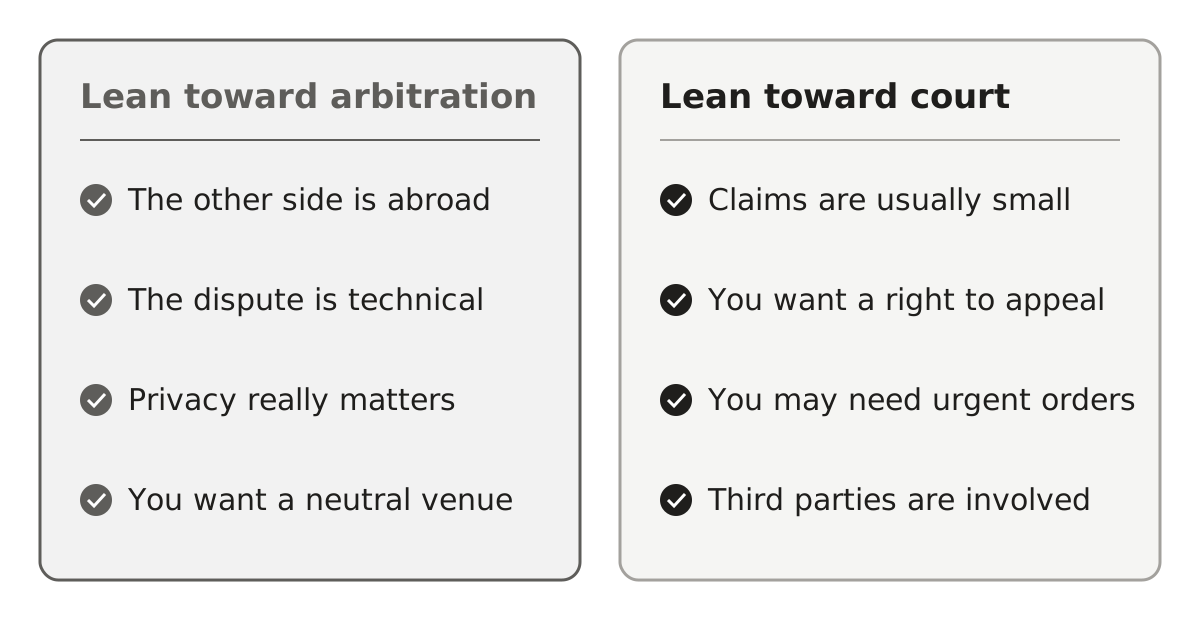
Most businesses don’t need one answer for every contract. A design studio in Austin with 40 local clients and a single big client in Germany might sensibly use Texas courts for the first group and arbitration for the second.
Writing the clause
Whichever you choose, draft the clause with care. A vague or contradictory clause leads to an expensive argument about where to argue, before anyone gets to the actual dispute.
A workable arbitration clause usually names:
- The institution and its rules, for example ICC, LCIA, SIAC, AAA/ICDR or DIAC
- The seat, which decides which country’s courts supervise the arbitration
- The number of arbitrators (one keeps costs down on smaller contracts)
- The language of the proceedings
- Any carve-outs, such as small claims or court applications for urgent relief
- Confidentiality, if it matters to you
For courts, use a forum selection clause that names the courts and says whether they’re exclusive, alongside a governing law clause. In the US, consider whether you want a jury trial waiver, which many states enforce but not all.
Plenty of contracts add a step before either route: a dispute escalation process with senior managers, then mediation, then arbitration or court. This settles a lot of disputes early. Put firm time limits on each stage so neither side can stall forever.
What to do this week
Pull your five biggest customer and supplier contracts and read the dispute clauses side by side. Most small businesses find a patchwork of copied templates: one says arbitration in New York, another says the courts of Delaware, a third says nothing at all. You can pull out the dispute resolution, governing law and jurisdiction terms from each contract with LegalWolf and compare them in one place.
For high-value or international deals, have a lawyer look at the clause before you sign. Changing it later needs the other side’s agreement, and that’s very hard to get once a dispute has started.
This article is general information, not legal or tax advice. Laws differ between countries and states and change over time, so check the rules that apply to you or speak to a qualified professional.