Are electronic signatures legally binding?
Yes. In the US, UK, EU, UAE, Canada, Australia and most other major economies, electronic signatures are legally binding for the vast majority of business contracts. The general rule in these places is that a signature can’t be refused legal effect just because it’s electronic. There are exceptions, such as wills, some property transfers and documents that must be witnessed or notarized. And how well an e-signature holds up in a dispute depends on the evidence behind it.
What counts as an electronic signature
The category is wider than most people expect. Depending on where you are, it can include:
- Typing your name at the bottom of an email or form
- Clicking an “I agree” button
- Drawing your signature on a touchscreen
- Signing through an e-signature platform
- A cryptographic digital signature backed by a certificate
The common thread is intent to sign. What matters is that the person meant to approve the document. That cuts both ways. Tom, a photographer in Vancouver, agreed a $2,400 wedding package over email, ending with “Sounds good, Tom.” In some circumstances, that can be enough to form a binding agreement, even though nobody thought of it as signing anything.
The rules by country
| Where | Main framework | Key points |
|---|---|---|
| United States | Federal ESIGN Act plus state laws, mostly based on the Uniform Electronic Transactions Act (UETA) | Generally valid; extra consent rules for some consumer dealings |
| European Union | eIDAS Regulation | Three levels: simple, advanced and qualified |
| United Kingdom | Electronic Communications Act 2000, the UK’s version of the eIDAS rules, and case law | Generally valid; deeds need extra formalities |
| Canada | Federal and provincial electronic commerce laws | Details vary by province |
| Australia | Federal and state Electronic Transactions Acts | Companies can now sign documents electronically |
| UAE | Federal law on electronic transactions and trust services | Some categories excluded or need more |
United States
ESIGN and the state electronic transaction laws, most of them based on UETA, give electronic signatures and records the same legal effect as paper for most transactions. The few states that didn’t adopt UETA, such as New York, have their own laws that do much the same job. When a business deals with consumers electronically, ESIGN can require specific disclosures and the consumer’s consent before electronic records replace paper ones.
European Union
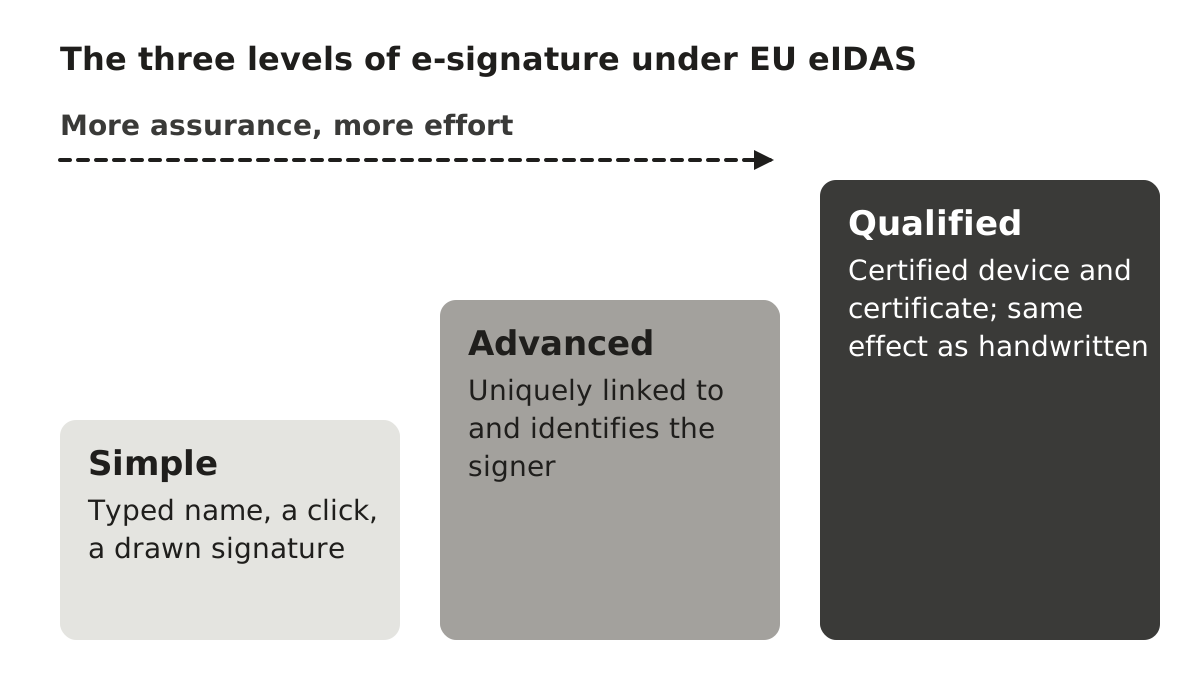
eIDAS sets out three levels. A simple electronic signature can’t be rejected as evidence just because it’s electronic. An advanced signature has to be uniquely linked to the signer and capable of identifying them. A qualified signature, made with a certified device and certificate, has the same legal effect as a handwritten one across the EU. Most commercial contracts only need simple or advanced, but national law can demand more for particular documents.
United Kingdom
English law has accepted electronic signatures for a long time, and the Law Commission concluded in 2019 that they can validly execute documents, including many where the law requires a signature. Deeds are the main complication. They usually need to be signed in front of a witness, and the prevailing view is that the witness should be physically present rather than on a video call.
UAE, Canada and Australia
The UAE’s federal electronic transactions law recognizes e-signatures and sets up higher-assurance trust services, but excludes or restricts some categories, such as certain personal status matters and documents involving real estate title or notarization. In Canada, each province has its own electronic commerce law alongside the federal rules, and Quebec has its own framework. Australia’s federal and state Electronic Transactions Acts support e-signatures, and company execution rules were updated to let companies sign documents electronically on an ongoing basis.
Documents that may need more than a click
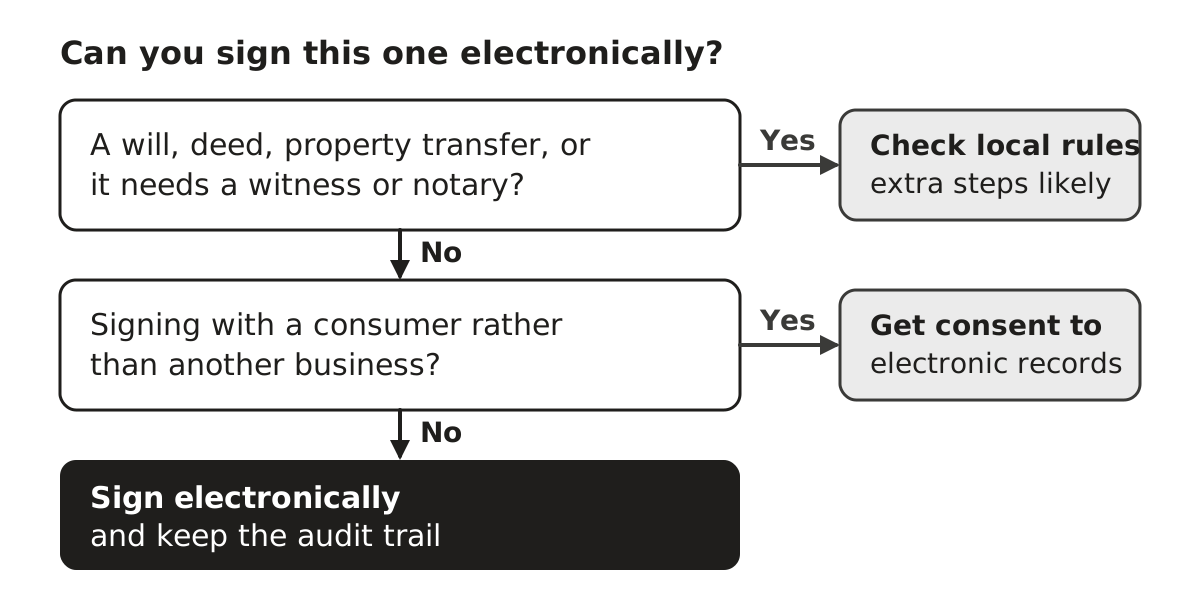
Even where e-signatures are widely accepted, some documents often need extra steps or a wet ink signature. Check the local rules for:
- Wills and some trusts
- Transfers of land and some property documents, depending on the land registry
- Deeds and powers of attorney
- Anything that must be witnessed or notarized (many US states now allow remote online notarization)
- Some family law documents
- Certain consumer notices, such as eviction, utility shutoff or insurance cancellation notices in the US
- Court filings and some government forms, which follow their own rules
- Documents you’ll need to use in another country
Making an e-signature hold up
An e-signature is only as strong as the evidence of who signed and what they signed. Good practice looks like this:
- Keep an audit trail. Who signed, when, from which email and IP address, and what steps they took.
- Check identity in proportion to the risk. For a high-value contract, an email link plus a code by text message, or ID verification.
- Lock the final version so it can’t be changed after signing, and send everyone a completed copy.
- Get consent to sign electronically, especially with consumers.
- Confirm authority. Make sure whoever signs for a company can actually bind it.
- Include a counterparts clause confirming that electronically signed copies count as originals.
For simple agreements, the sign PDF tool lets you sign a document without printing it. For bigger or regulated deals, use a platform that produces a full audit trail.
How they get challenged
Disputes over e-signatures tend to follow a few familiar lines:
- “I didn’t sign that.” Someone else had access to the email account or device. Audit trails and identity checks are the answer.
- “That’s not what I signed.” The document changed afterwards. Locked, tamper-evident files deal with this.
- “I didn’t know I was agreeing to anything.” Common with online terms. Clickwrap, where the user actively clicks to accept, is generally enforced more reliably than browsewrap terms tucked behind a link.
- “They had no authority.” The person signing wasn’t entitled to bind the company.
What to do now
For everyday business contracts, e-signatures are a safe, quick default, and we’d use them without a second thought. Before you rely on one for something unusual, check whether that type of document needs witnessing, notarization or a particular signature level where you are. Keep the signed file and its audit trail together, somewhere you can find them if a question comes up years later. LegalWolf can store signed contracts alongside their key dates so nothing goes missing.
This article is general information, not legal or tax advice. Laws differ between countries and states and change over time, so check the rules that apply to you or speak to a qualified professional.