Sole trader, LLC or corporation: choosing a business structure
If you’re working alone and the risk is low, trading as a sole trader (a sole proprietor, in US terms) is fine for the first year or so. Once there’s real money at stake, clients who could sue, staff, a lease or a co-owner, you’ll usually want a limited liability entity: an LLC in the US, a private limited company in the UK, or the local equivalent. A full corporation with shares to sell makes sense mainly when you plan to raise outside investment. Three questions decide it: how much personal risk you carry, how you want to be taxed, and how much admin you’re willing to do.
The names change from country to country, which trips people up. The US “sole proprietor” is the UK and Australian “sole trader”. A UK “Ltd” fills roughly the role a US LLC plays for small firms, though it’s taxed like a company rather than passing profits straight through. We’ll use the plain labels and flag the local ones as we go.
Sole trader: simple, cheap and completely personal
As a sole trader, you and the business are the same legal person. There’s nothing to form. In the UK you register with HMRC for Self Assessment. In most US states you may only need a local business license and, if you trade under a name other than your own, a DBA filing.
The appeal is real. Profits are taxed as your personal income, the bookkeeping is lighter, and you can stop trading without a formal wind-down. Priya, a freelance copywriter in Manchester billing £38,000 a year across five steady clients, has no pressing reason to incorporate yet.
So is the risk. Every debt and every judgment against the business is a debt and judgment against you. If a client sues for $60,000 over a blown deadline and wins, your savings and car (and in some cases your home) are exposed. Insurance helps with some claims. It won’t pay your suppliers.
LLCs and limited companies: what most small businesses end up with
A limited liability entity is its own legal person. It signs contracts, owns assets and owes its own debts. If it fails, creditors generally can’t reach your personal assets, provided you’ve kept the business genuinely separate from your own affairs.
In the US: the LLC
You form an LLC under state law by filing articles of organization. By default, a single-member LLC is taxed like a sole proprietorship and a multi-member LLC like a partnership, so profits pass through to the owners’ personal returns. An LLC can also elect to be taxed as an S corporation, which some owners use to cut self-employment tax once profits are healthy. That election comes with its own rules (a reasonable salary, payroll, eligibility limits), so run the numbers with an accountant first.
Costs vary more than people expect. Some states charge under $100 to form an LLC. Others have steep annual fees or franchise taxes, or require you to publish a notice of formation. Check your own state before assuming it’s cheap.
In the UK, Canada and Australia: the private company
In the UK, most small businesses that want limited liability register a private company limited by shares at Companies House. The company pays corporation tax on its profits (as of 2025, 19% where profits are £50,000 or less and 25% above £250,000, with marginal relief in between), and you take money out as salary or dividends. An Australian Pty Ltd and a Canadian corporation work in broadly the same way: a separate taxpayer with its own filings and its own bank account.
In the UAE: mainland or free zone
In the UAE the first decision is usually where to license. A mainland company is licensed by the relevant emirate’s economic department and can trade across the country. A free zone company is licensed by one of the many free zone authorities, is often quicker to set up, but faces limits on dealing directly with the local market. Some free zones also issue freelance permits. Federal corporate tax now applies to most businesses, with a 0% rate on taxable income up to AED 375,000 and 9% above that as of 2025. Qualifying free zone businesses can get different treatment, so take advice on which bucket you fall into.
Corporations: built for investors
A US C corporation (and its equivalents elsewhere) is the structure investors know. It can issue different classes of shares, grant stock options and take in venture money cleanly. That’s why so many US venture-backed startups incorporate in Delaware.
For an ordinary small business, the drawback is tax. A C corporation pays federal corporate tax on its profits (a flat 21% as of 2025), and shareholders are taxed again when profits come out as dividends. That second layer rarely makes sense for a bakery or a two-person agency. Honestly, if you aren’t raising outside money or handing out options, you probably don’t need one.
The three side by side
| Sole trader | LLC or limited company | Corporation | |
|---|---|---|---|
| Personal liability for business debts | Yes, unlimited | Generally no | Generally no |
| How profits are taxed | As your personal income | US LLC: passed through by default. UK Ltd: corporation tax, then personal tax on what you take out | Corporate tax, then tax on dividends |
| Setup and upkeep | Minimal | Moderate: registration and annual filings | Highest: board, share records, filings |
| Raising investment | Very hard | Possible, sometimes awkward | Designed for it |
| Typical fit | Freelancers, side projects, low-risk services | Most small businesses with real risk or co-owners | Startups raising capital |
The liability shield has holes
Forming an LLC or company doesn’t make you untouchable. Courts in many countries can look past the entity (Americans call it “piercing the corporate veil”) when owners treat the business like a personal wallet: mixing funds, paying the mortgage from the business account, or running it with no real capital.
The bigger hole is usually one you dig yourself. Banks, landlords and large suppliers routinely ask small business owners for a personal guarantee, which puts your own assets back on the line for that debt. And you’re always responsible for your own wrongdoing, like your own negligence or fraud, whatever entity you trade through.
- Open a business bank account and run everything through it. Nothing personal.
- Sign contracts in the company’s name with your title, such as “Jane Ortiz, Member, Ortiz Design LLC”, not just your own name.
- Keep the records your structure requires: resolutions or minutes where needed, annual filings on time.
- Show the company name and registration details on invoices and your website where local law requires it (UK companies must).
- Read any contract for guarantee wording before you sign it.
How to decide
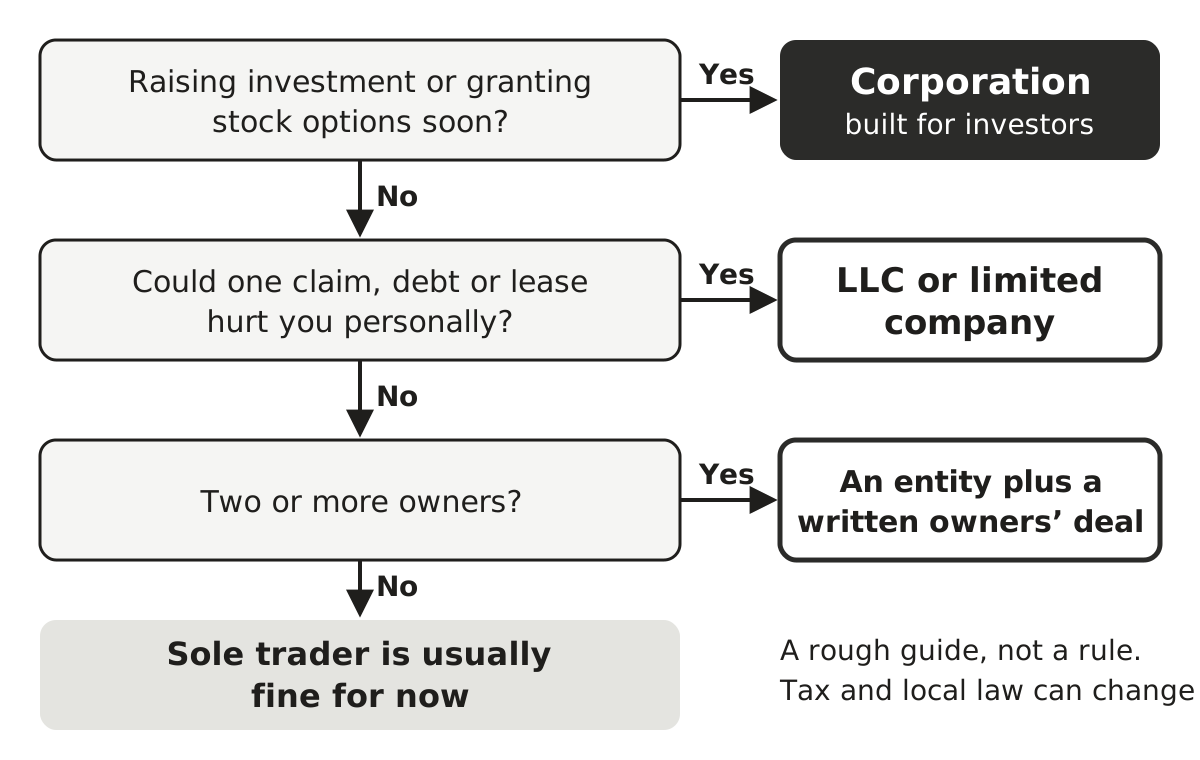
- Size up the risk. Could one bad client claim or unpaid bill hurt you personally? Physical work, professional advice, handling client data and hiring staff all push toward a limited entity.
- Run the tax numbers. Ask an accountant to compare your take-home under each option at your expected profit. The point where a UK limited company starts saving money shifts whenever rates change, so don’t trust a figure from an old blog post.
- Count the owners. Two or more? Use an entity and put an operating agreement or shareholders’ agreement in writing. Handshake partnerships cause some of the ugliest disputes we see.
- Think about investment. If you expect to raise money in the next year or two, talk to a startup lawyer about a corporation now. Converting later costs more.
- Check licensing rules. Some regulated trades must use particular structures, and in the UAE your license type and permitted activities drive most of the decision.
What to do next
You can change structure later. Plenty of businesses start as sole traders and incorporate once revenue and risk grow. The switch is mostly paperwork, plus moving bank accounts, registrations and contracts into the new entity. Contracts are the part people forget. Your existing client agreements are with you personally, so check each one’s assignment clause to see whether you can transfer it or need the client’s consent.
Once the entity exists, get the basics in place: an owners’ agreement if there’s more than one of you, a standard client contract (our services agreement template is a reasonable start), and a habit of putting tax money aside, which the tax set-aside calculator makes easier.
This article is general information, not legal or tax advice. Laws differ between countries and states and change over time, so check the rules that apply to you or speak to a qualified professional.