Business expenses: what’s usually deductible and what isn’t
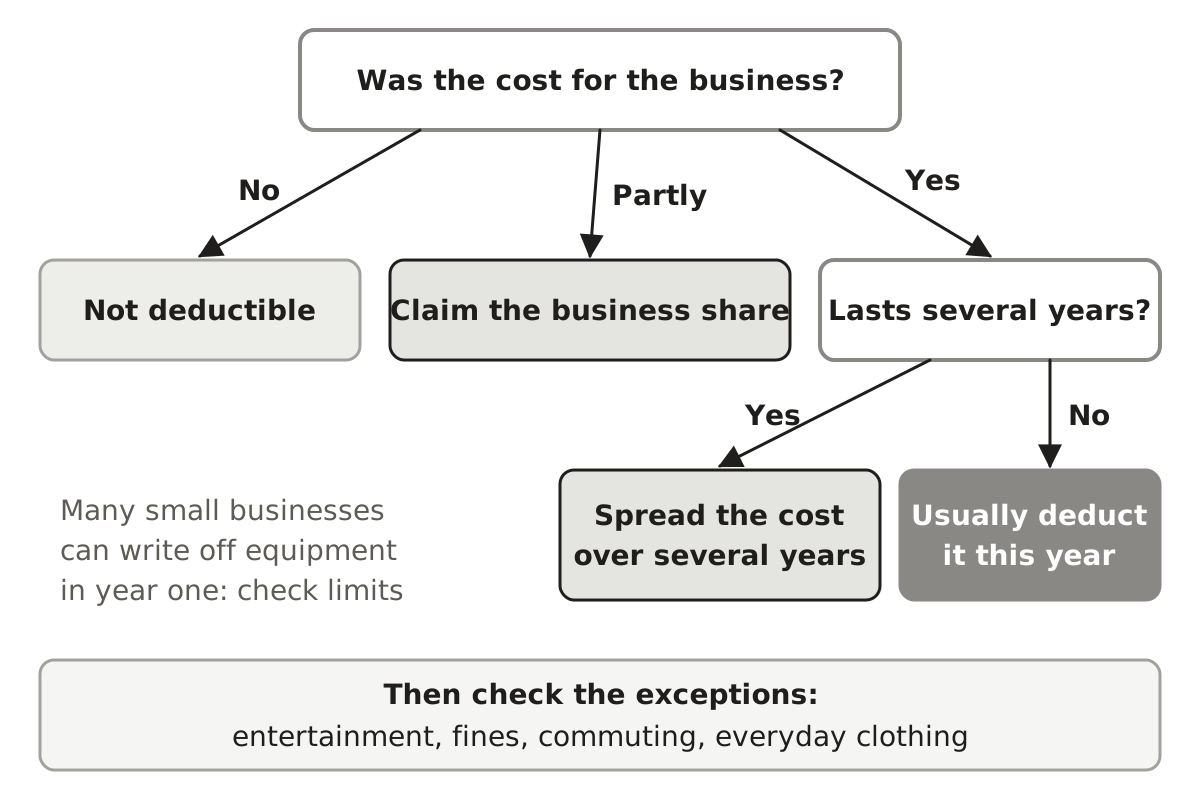
Most costs you incur to run your business are deductible, which means they reduce the profit you pay tax on. Rent, software, insurance, professional fees, marketing, business travel and equipment usually count. Personal costs, commuting, fines and, in many countries, client entertainment usually don’t. Costs that are partly personal, like your phone or car, can often be claimed for the business share only. The exact tests vary: the US asks whether a cost is “ordinary and necessary” for your business, while the UK asks whether it was incurred “wholly and exclusively” for your trade.
Every dollar or pound you miss here costs you your marginal tax rate. Every one you claim wrongly can cost you that plus interest and penalties. Both are worth avoiding.
The basic test in each country
The wording differs, but the idea is the same everywhere: the cost has to be connected to earning your business income.
- US: an expense is deductible if it’s ordinary (common in your line of business) and necessary (helpful and appropriate), and not a personal or capital cost.
- UK: a sole trader or company can deduct costs incurred wholly and exclusively for the purposes of the trade. Where a cost has a clear business part, that part can usually be claimed.
- Canada and Australia: broadly, costs incurred to earn business income are deductible, with specific rules for capital items, home offices, cars and entertainment.
What’s usually deductible
- Software and subscriptions you use for work: accounting, design tools, cloud storage, project management.
- Professional fees, including your accountant, lawyer and bookkeeper.
- Business insurance, such as professional indemnity, public liability or cyber cover.
- Marketing: your website, ads, printed materials, directory listings.
- Premises costs: rent, utilities and cleaning for a business space.
- Business travel: trips to see clients or work away from your usual base, including transport and accommodation.
- Bank and payment fees, including card processing charges.
- Training that keeps your existing skills up to date. Training for a brand new career is often treated differently.
- Equipment, usually through depreciation or capital allowances, although many small businesses can write off the full cost in the first year.
What usually isn’t
This list is where most mistakes happen, because many of these feel like business costs.
- Commuting between home and your regular place of work isn’t deductible in the US or the UK, even if you take calls on the way.
- Client entertainment generally isn’t deductible in the UK. In the US, entertainment is generally not deductible, but business meals are often 50% deductible.
- Fines and penalties, including parking tickets and late-filing penalties, aren’t deductible in most countries.
- Everyday clothing isn’t deductible, even if you only wear that suit to meetings. Uniforms and protective gear usually are.
- Your own drawings as a sole trader aren’t an expense. They’re just you taking profit out.
- Income tax on your business profits isn’t deductible against those profits.
| Expense | US (as of 2025) | UK (as of 2025) |
|---|---|---|
| Meal with a client | Often 50% deductible | Generally not deductible |
| Commuting | Not deductible | Not deductible |
| Home office | Actual costs, or a simplified $5 per square foot up to 300 square feet, if the space is used regularly and exclusively for business | A share of actual costs, or a monthly flat rate of £10, £18 or £26 depending on hours worked at home |
| Business driving | Actual costs, or a standard mileage rate of 70 cents per mile for 2025 | Actual costs, or 45p per mile for the first 10,000 business miles and 25p after |
| Fines and penalties | Not deductible | Not deductible |
| Work clothing | Only if unsuitable for everyday wear | Uniforms and protective clothing only |
Mixed-use costs: claim the business share
Plenty of costs are partly business and partly personal. The usual approach is to work out a fair business percentage and claim that part, with evidence to back it up.
Take Nadia, a wedding photographer in Toronto. She uses her phone for client calls and personal use, so she reviews three typical months of bills, finds about 60% of the use is for business, and claims 60%. Her car goes to shoots and to the supermarket, so she keeps a mileage log. Her home office is a spare room she uses only for editing and meeting clients. In Canada, a home workspace qualifies if it’s your principal place of business or used only for business and regularly for meeting clients, so her claim is on solid ground.
The log is the part people skip. Tax authorities are used to seeing round numbers like “50% business” with nothing behind them. A mileage app or a simple spreadsheet, kept as you go, is far more convincing than an estimate made at year end.
Day-to-day costs versus assets
A $40 monthly software subscription is a day-to-day expense, deducted in the year you pay it. A $2,400 camera that lasts five years is a capital asset. Traditionally, you’d spread its cost over several years through depreciation (US, Canada, Australia) or capital allowances (UK).
In practice, many small businesses can deduct equipment in full in the year they buy it. The UK’s Annual Investment Allowance covers most plant and machinery for most small businesses, US rules allow immediate expensing of many equipment purchases, and Australia has periodically offered instant asset write-offs for small businesses. The limits and eligibility change often, so check the current year’s rules before assuming a big purchase comes off this year’s profit.
Keep the evidence
A deduction is only as good as the paperwork behind it. For each expense, you want the receipt or invoice, proof of payment and, where it isn’t obvious, a note on the business purpose. “Lunch, $86” is weak. “Lunch with Sam Ortiz, Harbor Labs, discussing Q3 retainer, $86” is what an auditor wants to see.
Contracts count as evidence too. If you pay a retainer to a lawyer or a subcontractor, keep the engagement terms alongside the invoices. And put your tax set-aside on a real footing with our tax set-aside calculator, which lets you factor in expected expenses.
Next steps
- Go through last year’s bank statements and flag every business cost, including small subscriptions.
- Pick a fair business percentage for each mixed-use cost and write down how you got it.
- Start a mileage log if you drive for work.
- Separate capital purchases from day-to-day costs and check the current first-year write-off rules.
- Ask your accountant about anything unusual before you claim it, not after.
This article is general information, not legal or tax advice. Laws differ between countries and states and change over time, so check the rules that apply to you or speak to a qualified professional.