Gulf minimum top-up taxes: the 2026 and 2027 deadlines
Large multinational groups with operations in the Gulf are heading into their first minimum tax filing season. The UAE, Qatar, Kuwait and Bahrain have each introduced a 15% domestic minimum top-up tax for financial years starting on or after 1 January 2025. It applies to groups with consolidated revenue of at least EUR 750 million in two of the previous four years. For calendar-year groups, the UAE and Qatar registration deadlines fall in November 2026, and the first returns in all four countries land in 2027.
These taxes come from the OECD’s Pillar Two rules, and they’re designed so the Gulf state, not the parent company’s home country, collects any top-up where local profits are taxed below 15%. If your group is in scope, the compliance work is heavy. If it isn’t, you can stop reading after the next section.
Who this affects
- Groups with consolidated revenue of EUR 750 million or more in at least two of the four years before the year in question.
- Both Gulf-headquartered groups and foreign groups with Gulf subsidiaries, branches or permanent establishments.
Smaller businesses, freelancers and most family companies aren’t affected. For them, the ordinary corporate tax rules are what matter.
What each country requires
United Arab Emirates
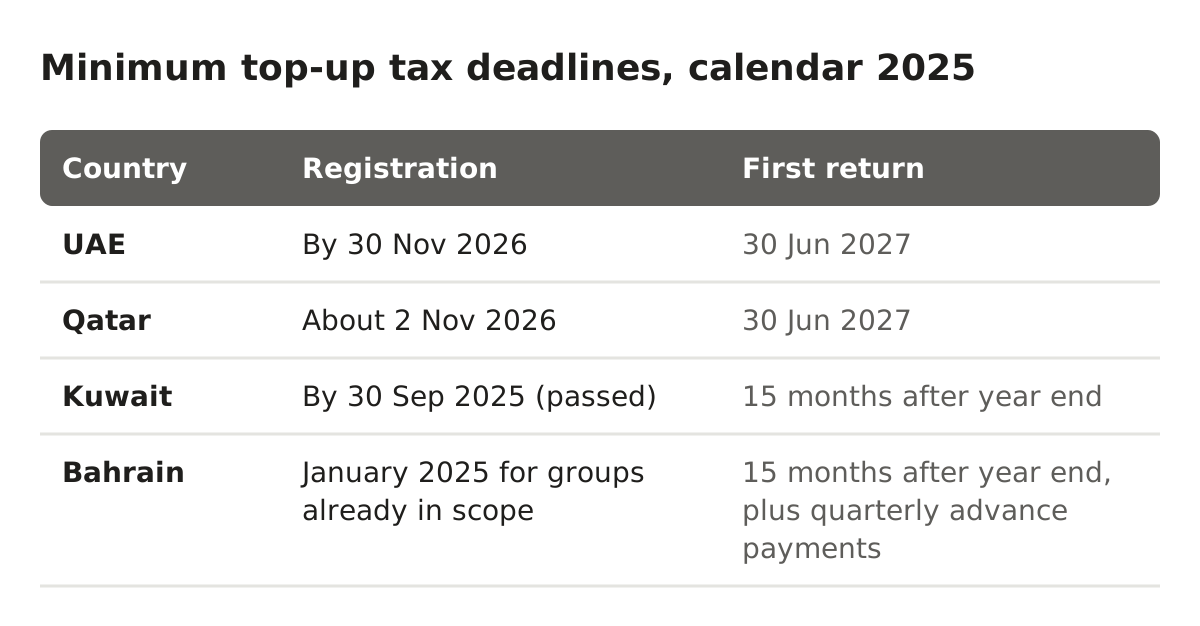
Cabinet Decision No. 142 of 2024 introduced the UAE’s domestic minimum top-up tax. EY notes it doesn’t adopt the income inclusion rule or the undertaxed profits rule, only the domestic tax. The top-up tax return is due 15 months after the end of the financial year, or 18 months for the first year, so 30 June 2027 for a calendar 2025 year. Penalty relief is available through 30 June 2028 where groups have taken reasonable steps to comply.
Registration is the near-term deadline. According to Simmons & Simmons, FTA Decision No. 12 of 2026 requires registration within seven months of the end of the first in-scope financial year, with a transitional deadline of 30 November 2026 for financial years ending before 30 April 2026. The penalty for a designated filing entity that fails to register is AED 10,000 per entity, not once per group.
Qatar
Qatar’s rules include both a domestic minimum top-up tax and an income inclusion rule, which lets Qatar tax low-taxed foreign subsidiaries of Qatari parent companies. The General Tax Authority opened registration on its Dhareeba platform on 2 August 2026, and in-scope groups must register within three months, which KPMG puts at 2 November 2026. The GloBE information return, the domestic top-up tax return and the income inclusion rule return for 2025 are due by 30 June 2027.
Kuwait
Decree-Law No. 157 of 2024 introduced Kuwait’s tax, with executive regulations issued by Ministerial Decision No. 55 of 2025. Registration was due before 30 September 2025, so if you’re in scope and haven’t registered, you’re already late. Returns are due within 15 months of the year end, and EY notes they must be audited by firms the Ministry has approved. In-scope entities move out of Kuwait’s corporate income tax, the National Labor Support Tax and Zakat. Late filing penalties run from 5% to 25% of the tax.
Bahrain
Decree-Law No. 11 of 2024 introduced Bahrain’s tax, with executive regulations issued in December 2024. Groups already in scope on 1 January 2025 had to register within 30 days of that date. Returns are due within 15 months of the year end. Bahrain also requires quarterly advance payments, due 60 days after the end of each quarter, although for the 2025 transition year the first payment could be deferred to the second due date.
What it means in practice
Take a European industrial group with EUR 2 billion of revenue and a Dubai mainland subsidiary earning AED 40 million of profit. In rough terms, if that subsidiary’s effective tax rate under the Pillar Two calculation comes out at about 9%, the UAE top-up is the gap to 15%, around 6%, or about AED 2.4 million. The real calculation is more involved (adjusted profits, covered taxes and a substance-based carve-out all move the number), so treat this only as a sense of scale.
The admin burden is the part groups tend to underestimate. That same group, if it also has a Doha branch and a Kuwait office, faces three sets of registrations, three return formats and three payment calendars. And a group with a Bahrain entity has cash going out quarterly, not once a year.
Honestly, the biggest risk right now isn’t the tax itself. It’s missing a registration. The UAE fine applies per entity, and Kuwait’s deadline has already passed.
What to do now
- Confirm whether your group met the EUR 750 million test in two of the four years before 2025, and again for 2026.
- List every Gulf entity, branch and joint venture, and map which country’s rules apply to each.
- UAE: register on EmaraTax before 30 November 2026 if your first in-scope year ended before 30 April 2026.
- Qatar: register on Dhareeba within three months of 2 August 2026, so by early November.
- Kuwait: if you missed the September 2025 registration, register now and take advice on penalties.
- Bahrain: check your quarterly advance payments are being calculated and paid.
- Plan the data work for 30 June 2027 now: the first returns need numbers most finance teams don’t produce today.
Our deadline calculator helps you count 15 and 18 month filing windows from your year end. This article covers the UAE, Qatar, Kuwait and Bahrain. If your group has entities elsewhere in the Gulf, check those rules separately. As of September 2026, the region’s authorities are still issuing guides and decisions on these taxes, so expect more detail before the first returns are due.
Sources
- EY: UAE issues domestic minimum top-up tax legislation
- Simmons & Simmons: UAE issues new top-up tax guides and filing decision
- KPMG: Qatar Pillar Two registration service launched
- EY: Kuwait issues executive regulations to the Kuwait DMTT Law
- OECD Pillars: Bahrain issues executive regulations for the 2025 domestic top-up tax
This article is general information, not legal or tax advice. Laws differ between countries and states and change over time, so check the rules that apply to you or speak to a qualified professional.