Offer letters vs. employment contracts
An offer letter is a short document that confirms the job, pay and start date and invites the candidate to accept. An employment contract is the full rulebook: duties, pay, hours, leave, termination, confidentiality, IP and any restrictions after the job ends. In most US states, a well-written offer letter for an at-will role is often all you use. In the UK, EU, Canada and Australia you’ll usually need more, either because the law requires certain terms in writing or because a missing term costs you money later.
The two aren’t either-or. Plenty of businesses send an offer letter first and a contract second. What matters is that together they say what you mean, and that the letter doesn’t accidentally promise something you didn’t intend.
What each document usually covers
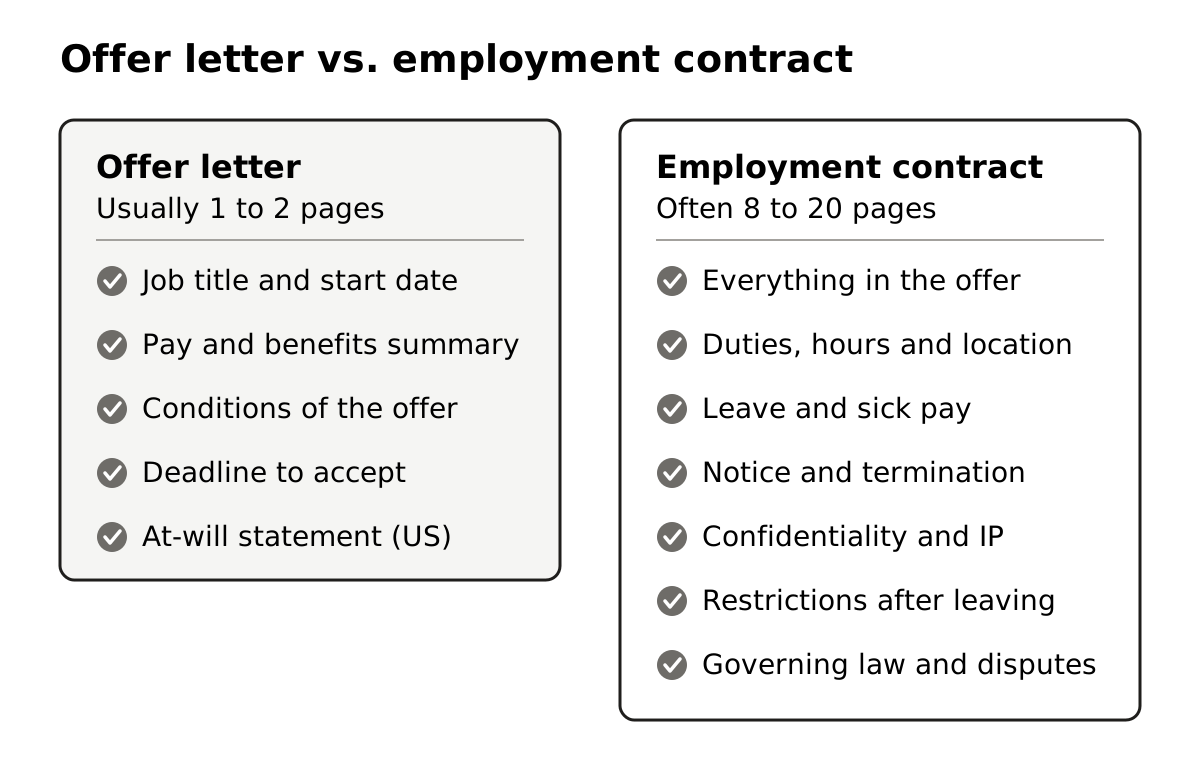
The biggest difference is depth. An offer letter answers “what’s the deal?” A contract deals with the harder moments: the employee wants to leave, you want them to, they invent something, or they walk out with a client list.
In the US, an offer letter is often enough
Most US employment is at will, meaning either side can end it at any time for any lawful reason. Montana is the notable exception, with its own rules on dismissal after a probationary period. Because there’s no required notice period and few mandatory terms, many employers skip a formal contract for regular staff and use an offer letter, a handbook, and a separate confidentiality and invention assignment agreement.
If that’s your approach, the offer letter needs to be tight. Watch for these:
- At-will language. Say plainly that employment is at will and nothing in the letter changes that. Avoid phrases like “permanent position” or “$72,000 for your first year,” which someone could read as a promise of a year’s job.
- Conditions. If the offer depends on a background check, references or proof of right to work (the I-9 process), say so.
- Pay, described accurately. State whether the role is exempt or non-exempt from overtime, how often payroll runs, and how bonuses and commissions work. If bonuses are discretionary, say that.
- IP and confidentiality in their own document. A short standalone agreement covering confidentiality and IP assignment is easier to enforce and update than a few lines buried in a letter. Several states limit what an employee invention assignment can cover and require you to tell employees about those limits.
- An entire-agreement line. One sentence saying the letter replaces earlier discussions helps stop arguments over what the hiring manager said on the phone. See entire agreement.
Some US roles do call for a proper contract: senior executives, anyone with guaranteed severance or equity, employees in Montana, and anyone signing a non-compete in a state that requires specific terms or advance notice.
In the UK, written terms are due on day one
UK employers must give employees and workers a written statement of the main terms of employment on or before their first day. That covers pay, hours, holiday, start date, job title, place of work, notice periods, probation and more. A few items, like pension details, can follow in a separate document within two months. An offer letter alone rarely covers everything.
So most UK businesses send an offer letter, then a full contract that doubles as the written statement. Skipping it isn’t a standalone claim in most cases, but if an employee brings certain other tribunal claims, the tribunal can add extra compensation for the missing statement.
The EU, Canada, Australia and the UAE
In the EU, the Transparent and Predictable Working Conditions Directive means employers must give workers written information on the core terms, generally within the first week, with some details allowed within a month. Each country implements this its own way, and many (Germany, France, Spain among them) also have sector-wide collective agreements that set pay and conditions.
In Canada, a written contract matters most for termination. Without a clear, enforceable clause limiting notice to the provincial employment standards minimum, courts can award “reasonable notice” under common law, which for a long-serving manager can mean many months of pay. Courts read these clauses strictly, and one badly worded sentence can sink the whole clause.
In Australia, most employees are covered by a modern award or enterprise agreement that sets minimum pay and conditions, and new employees must be given the Fair Work Information Statement. A contract can add to those minimums but can’t go below them.
In the UAE, private-sector employment contracts are registered through the Ministry of Human Resources and Emiratisation on a standard form, and the offer letter the employee signs should match it. Differences between the offer and the registered contract are a common source of disputes.
When the offer letter becomes the contract anyway
Even a “non-binding” offer letter can create legal obligations. In most countries, once a candidate accepts an offer, a contract exists on the terms offered. Withdraw it after acceptance and, depending on where you are, you may owe notice pay (in the UK, for example) or face a claim that the candidate relied on your promise when they quit their old job.
Take Priya, who accepted a $95,000 marketing role at a software company in Austin, resigned from her old job, and then had the offer pulled two weeks before her start date. At-will employment weakens her claim in many states, since the company could in principle have let her go on day one. But some states allow claims based on reliance on a promise, and the reputational damage to the company is real either way. If you might need to pull an offer, write the conditions into it up front.
Before you send anything
- Job title, start date, place of work (or remote arrangement) and who they report to.
- Pay, pay frequency, overtime status, and how bonuses, commissions or equity work.
- Hours, probation and benefits, or where to find the details.
- Any conditions of the offer and a deadline to accept.
- Termination and notice period terms, as local law requires.
- Confidentiality, IP assignment and any restrictions, ideally in a separate signed agreement.
- A line confirming that this document, plus any named attachments, is the whole agreement.
Next steps
Take the last offer letter you sent and read it next to your standard contract, if you have one. Do the numbers match? Does the letter promise anything the contract doesn’t mention? If you hire in more than one country, keep a separate template for each, because a single global letter will be wrong somewhere. You can run your templates through LegalWolf to spot missing or conflicting terms before the next hire.
This article is general information, not legal or tax advice. Laws differ between countries and states and change over time, so check the rules that apply to you or speak to a qualified professional.