Reverse charge VAT: who pays the tax on B2B services
Under the reverse charge, the customer accounts for VAT instead of the supplier. It’s most common on business-to-business services that cross a border. The supplier invoices without VAT and notes that the reverse charge applies. The customer then records the VAT on its own return, both as tax due and as tax it can reclaim, so for a business that can recover VAT in full, the two entries cancel out and no money changes hands.
It’s one of those rules that sounds odd until you see why it exists. Then it makes a lot of sense.
Why the reverse charge exists
Without it, a freelancer in Dublin who sells consulting to clients in France, Spain and Italy would have to register for VAT in all three countries, charge each country’s rate and file returns in three languages. The reverse charge lets the supplier stay registered at home while the tax still ends up in the country where the service is used.
Some countries also use a domestic version to fight fraud in sectors where suppliers were collecting VAT and disappearing before paying it over. If the customer accounts for the tax, there’s nothing for a dishonest supplier to pocket.
How it works: an example
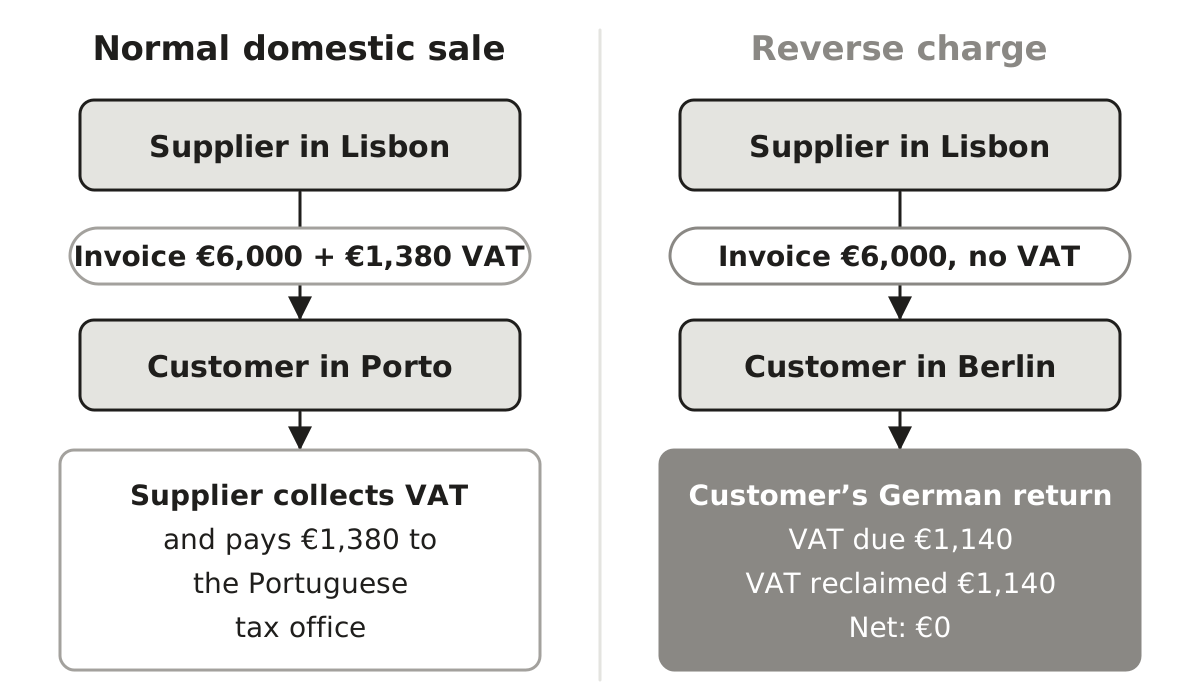
A design studio in Lisbon invoices a software company in Berlin €6,000 for a brand identity project. If the client were in Portugal, the studio would add Portuguese VAT at 23%. Because the client is a VAT-registered business in Germany, the general rule for B2B services puts the place of supply in Germany.
So the studio invoices €6,000 with no VAT and notes that the reverse charge applies. The Berlin company records German VAT of €1,140 (19% of €6,000) as output tax on its return and the same €1,140 as input tax. Net effect: zero. The German tax office still sees the transaction, and the studio never has to deal with it.
When it applies
Cross-border B2B services in the EU
For most services supplied to a VAT-registered business in another EU country, the place of supply is where the customer is established, and the customer applies the reverse charge. There are exceptions with their own rules, including services connected to land and property, admission to events, passenger transport and restaurant services. Check those separately.
The UK after Brexit
A UK business selling most services to a business customer outside the UK usually treats the sale as outside the scope of UK VAT. An EU customer would then apply the reverse charge in its own country. Going the other way, a UK VAT-registered business buying services from abroad generally accounts for UK VAT under the reverse charge on its return.
One trap for small UK businesses: the value of services you receive under the reverse charge counts toward the UK VAT registration threshold. A consultancy with £70,000 of UK sales that buys £25,000 of software development from a contractor in Poland could find itself over the £90,000 threshold (as of 2025) without selling a penny more.
Domestic reverse charges
Some reverse charges apply between two businesses in the same country. The UK uses one for many construction services within the Construction Industry Scheme, and for certain goods such as mobile phones and computer chips in some cases. Several EU countries have their own for sectors like scrap metal or emissions allowances. If you work in one of those industries, check the local rules. The invoice wording is usually specific.
Outside Europe
The idea isn’t unique to Europe. The UAE applies a reverse charge to many services imported by VAT-registered businesses. Australia has a reverse charge on imported services for GST-registered businesses that can’t claim full input tax credits. The details differ enough that you should check each country on its own terms.
What your invoice should say
A reverse charge invoice still has to be a proper VAT invoice, with a few changes:
- Your VAT number and your customer’s VAT number.
- No VAT amount charged, with the net price shown clearly.
- A clear note that the reverse charge applies. “Reverse charge” is the usual wording, and some countries expect a reference to the relevant rule.
- All the usual details: invoice number, date, description of the services, and both parties’ names and addresses.
In the EU, suppliers normally also report these B2B service sales on a recapitulative statement, often called an EC Sales List, so the tax authorities can match both sides. Our invoice generator lets you add the reverse charge note and leave the VAT line at zero.
| Who | What they do under the reverse charge |
|---|---|
| Supplier | Checks the customer is a business, invoices without VAT, adds the reverse charge note, reports the sale where required |
| Customer | Records the VAT as output tax and input tax on its own return, at its own country’s rate |
| Both | Keep the invoice and evidence of the customer’s business status |
Mistakes that cost real money
- Not checking the VAT number. In the EU, check it on the VIES system and keep a record of the result. If the customer turns out not to be a business, you may owe VAT yourself.
- Charging your own VAT by mistake. The customer usually can’t reclaim foreign VAT on its return, so it will ask you for a credit note and a corrected invoice. That delays payment.
- Using the reverse charge for consumers. It only applies to business customers. Digital services sold to EU consumers are taxed at the customer’s rate, usually reported through the One Stop Shop once your EU-wide cross-border sales pass €10,000 a year.
- Forgetting partially exempt customers. Banks, insurers and many healthcare businesses can’t reclaim all their VAT. For them, the reverse charge is a real cost, and they’ll look closely at your pricing.
- Customers forgetting to self-account. If you’re the buyer, missing the entries on your return can bring penalties even when the net tax is zero.
Contracts matter here too. State that prices exclude VAT and that, where the reverse charge applies, the customer accounts for it. That sentence in your services agreement saves an awkward email later. It’s also worth checking the governing law clause on any cross-border deal, since tax treatment follows the facts of the supply, not the law you chose for the contract.
Next steps
- List your cross-border business customers and check each VAT number is valid.
- Update your invoice template with a reverse charge note and a field for the customer’s VAT number.
- If you buy services from abroad, confirm you’re recording the reverse charge on your own return.
- In the UK, add reverse charge purchases to your turnover when checking the registration threshold.
- Ask an accountant about any service that might fall under an exception, such as event or property work.
This article is general information, not legal or tax advice. Laws differ between countries and states and change over time, so check the rules that apply to you or speak to a qualified professional.