Saudi labor law changes: 180-day probation and new notice rules
Saudi Arabia’s amended Labor Law is now in force. The Ministry of Human Resources and Social Development (HRSD) says the changes took effect on 19 February 2025. They rewrite 38 articles, delete seven and add two. Some law firm summaries give the start date as 18 February, but for practical purposes every private-sector employer in the Kingdom is now working under the new text. If you hire in Saudi Arabia directly, through a branch, or through an employer of record, it’s time to pull out your contract templates.
The headline changes are a longer probation period, a shorter notice period for employees who leave an open-ended contract, and a defined process for resignations. There are also new leave entitlements and an express duty not to discriminate. None of this is dramatic on its own. Taken together, though, it means most employment contracts drafted before 2025 are now out of step with the law.
What changed
The Council of Ministers approved the amendments in August 2024, and the ministry said they would take effect 180 days after publication in the Official Gazette. Based on the ministry’s announcements and law firm summaries of the amended text, these are the changes most employers will notice:
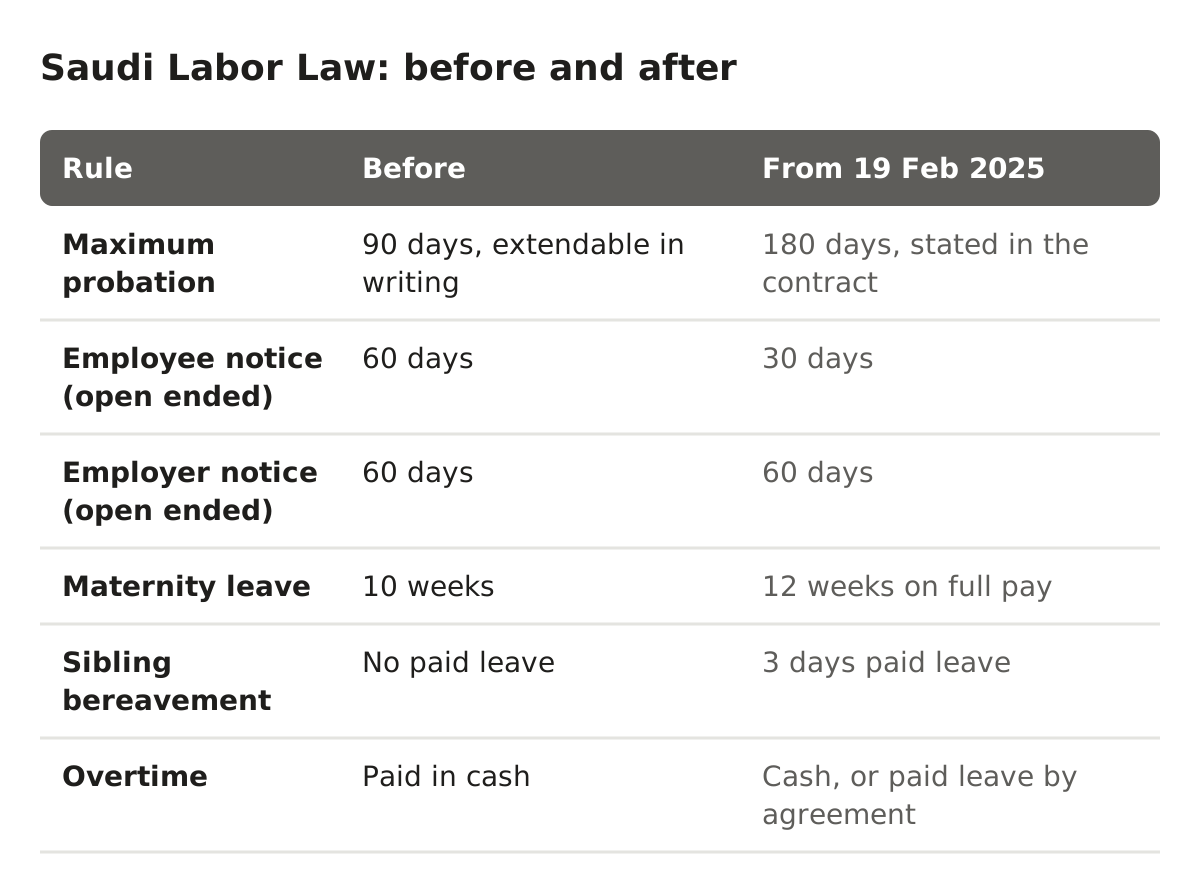
- Probation of up to 180 days. The old position was 90 days, which could be extended by written agreement. Now the parties can agree a probation period of up to 180 days from the outset, and the length has to be written into the contract. Either side can end the contract during probation.
- Shorter notice for employees on open-ended contracts. An employee who ends an indefinite contract gives 30 days’ notice (it used to be 60). An employer who ends one still gives 60 days.
- A defined resignation process. A resignation is now a written statement by the employee. If the employer doesn’t respond within 30 days, it’s treated as accepted. The employer can delay the end date by up to 60 days where the business needs it, with written reasons. The employee can withdraw a resignation within seven days, as long as it hasn’t been accepted yet.
- Fixed terms for non-Saudi staff. According to Rödl & Partner’s summary, a non-Saudi employee’s contract that doesn’t state its length is treated as a one-year contract from the start date, renewing for the same period if the work carries on. That replaces the old link to the work permit’s expiry.
- More leave. Maternity leave goes to 12 weeks on full pay, six of which must be taken after the birth. Fathers get three days’ paid leave, to be taken within seven days of the birth. Employees also get three days’ paid leave on the death of a sibling.
- Paid leave instead of overtime pay. With the employee’s agreement, overtime can be compensated with paid time off. The way overtime is calculated hasn’t changed.
- Housing and transport. Employers must provide accommodation and transport, or pay an equivalent allowance.
- Equal treatment. The law now says expressly that employers must treat employees equally, and bars discrimination on grounds including gender, age, nationality, marital status and disability.
- Heavier fines for unlicensed labor supply. Recruiting or supplying workers without a license now carries a fine of SAR 200,000 to SAR 500,000.
Who this affects
Every employer covered by the Labor Law. That includes foreign companies with a Saudi branch or subsidiary, regional headquarters in Riyadh, and groups that hire through an employer-of-record provider. If you use an EOR, the contract between the provider and your worker has to follow the new rules, so ask to see the updated template rather than assuming it’s been done.
Freelancers and businesses that engage them are affected less directly. A genuine independent contractor on a services agreement isn’t an employee, so the new probation and notice rules don’t apply to that contract. The dividing line still matters, though. If your "contractor" works fixed hours under your direction for months at a time, a Saudi labor court may see an employee, and then all of the above applies.
Key dates
- August 2024: the Council of Ministers approves amendments to 38 articles, the removal of seven and the addition of two.
- 180 days after gazette publication: the date the ministry set for the changes to take effect.
- 19 February 2025: HRSD announces that the amendments are in force, with updated executive regulations to follow.
What it means in practice
Take Layla, who runs a 25-person software consultancy in Riyadh for a Dubai-based group. On 1 March 2025 she hires a senior developer, Omar, on an open-ended contract at SAR 18,000 a month.
Probation. Her old template says 90 days. She can now agree up to 180 days, which suits a senior hire whose work she can’t judge in a quarter. The catch is that it has to be in the contract. A vague reference to "the statutory probation period" isn’t good enough, in my view. Write the number of days.
Resignation. Say Omar resigns in writing on 1 October. His notice is 30 days, so absent anything else his employment ends around 31 October. If Layla is halfway through a client delivery, she can delay the end date by up to 60 days, but she has to give written reasons. If she simply ignores the letter, it counts as accepted after 30 days. That last point catches people out: silence is now a decision.
Ending the contract herself. If Layla ends Omar’s open-ended contract, she owes 60 days’ notice. That asymmetry (30 days for him, 60 for her) is deliberate, and it’s worth budgeting for. On SAR 18,000 a month, the notice period alone represents roughly SAR 36,000 of salary.
Overtime. If Omar works 20 extra hours in a release week, they can agree that he takes paid time off instead of overtime pay. Get the agreement in writing each time, or put a clear consent mechanism in the contract.
What to do now
- Update your contract templates: state the probation length in days, set notice at 30 days for the employee and 60 for the employer on open-ended contracts, and state the term for non-Saudi staff.
- Revise your leave policy for 12 weeks’ maternity leave, three days’ paternity leave within seven days of the birth, and three days’ bereavement leave for a sibling.
- Write a resignation procedure: who receives resignations, how the date is logged, who decides within 30 days, and how a deferral is documented with reasons.
- Add an overtime consent form if you want to offer time off instead of pay.
- Check that offer letters either provide housing and transport or pay an allowance for them.
- Confirm that any recruiter or labor supplier you use is licensed. The fines for unlicensed supply are steep.
- Review job adverts and promotion criteria against the new equal treatment rule.
Our deadline calculator helps you count notice periods from the date a resignation lands, and the notice period entry in our glossary explains how notice clauses usually work in contracts. If you’re ending an arrangement with a contractor rather than an employee, the termination notice template is a sensible starting point.
Sources
- Ministry of Human Resources and Social Development: Cabinet approves key amendments to Labor Law articles
- Argaam: HRSD Ministry says amendments to Labor Law take effect today
- King & Spalding: Amendments to the Saudi Labor Law approved
- Rödl & Partner: Saudi labor law 2025, the most important amendments and their impact
This article is general information, not legal or tax advice. Laws differ between countries and states and change over time, so check the rules that apply to you or speak to a qualified professional.