The UAE’s new Civil Transactions Law: what changes on 1 June 2026
The UAE has a new civil code. Federal Decree-Law No. 25 of 2025, issued on 30 December 2025, replaces the Civil Transactions Law of 1985 and takes effect on 1 June 2026. This is the general law underneath almost every contract governed by onshore UAE law: sales, services, leases, guarantees, loans and partnerships all rest on it unless a more specific law says otherwise. If you draft, negotiate or litigate UAE contracts, or you just sign them, this one reaches you.
Much of the structure of the old code survives. What’s new is a set of express rules on how parties behave before a contract is signed, a duty to share material information, a lower age of majority, and clearer drafting on choice of law and abuse of rights. Some of these codify what UAE courts were already doing. Others are real changes.
What changed
Good faith now applies to negotiations
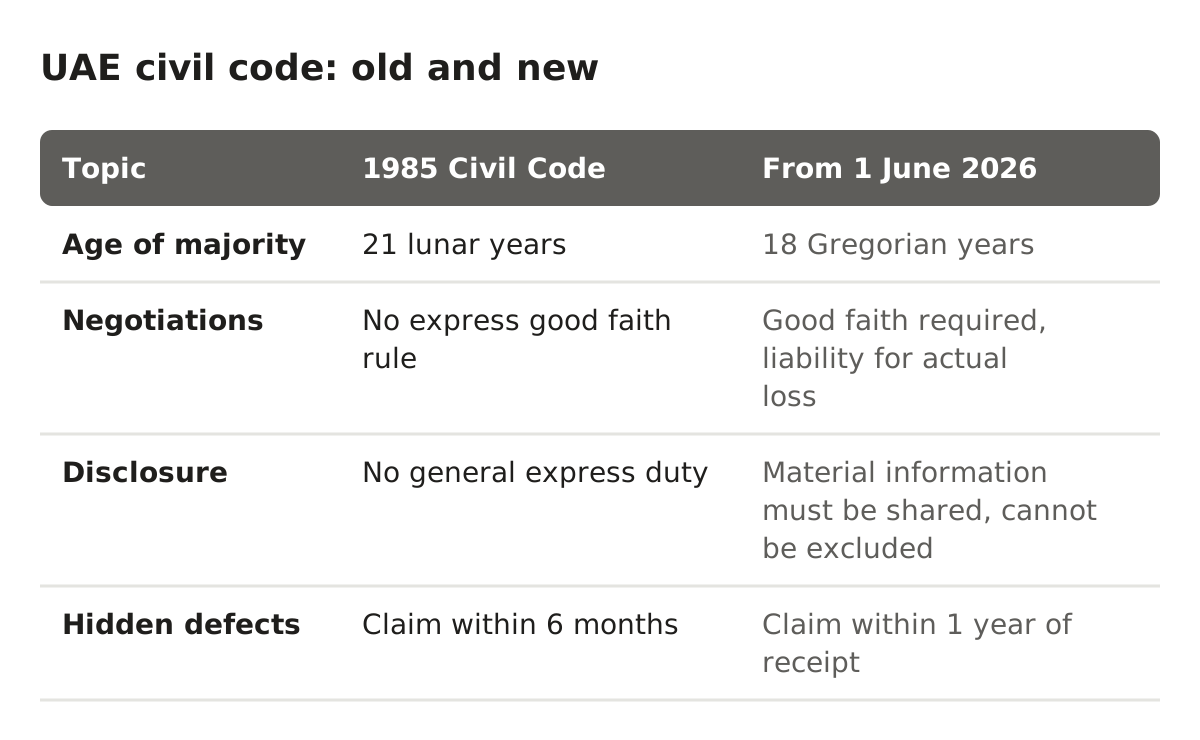
According to Squire Patton Boggs, Article 121 requires every stage of negotiation to meet the standard of good faith. A party that negotiates or walks away in bad faith is liable for the actual damage it causes, but not for the other side’s lost profits. Deliberately withholding material information during negotiations counts as bad faith.
A duty to disclose that can’t be contracted out
Article 122 requires both parties to take due care in giving each other relevant information. Information is material if it’s directly and necessarily connected to the substance of the contract or to the characteristics of the parties. A contract term that tries to exclude this duty is void, and Bracewell notes that deliberate non-disclosure may be grounds to annul the contract.
Age of majority drops to 18
Full legal capacity now starts at 18 Gregorian years, down from 21 lunar years. That changes who can sign contracts, open accounts and act as a party without a guardian.
Choice of law and abuse of rights
Article 19 says contractual obligations, in form and substance, are governed by the law the parties expressly chose, with fallback rules where they haven’t. Article 106 gives a more structured test for when using a legal or contractual right becomes an abuse, for example where the benefit is out of all proportion to the harm it causes.
Other changes worth knowing
- Framework agreements are formally recognized (Article 138), so parties can agree key terms for a series of future contracts in advance.
- Interpretation expressly takes in good faith, commercial custom, the surrounding circumstances and the parties’ relative positions.
- Hardship. Courts can rebalance or end a contract where exceptional, unforeseeable events make performance excessively onerous without making it impossible. Meysan’s analysis notes that a clause trying to exclude this relief won’t work.
- Unfair contracts. Bracewell highlights a broader exploitation rule that covers economic imbalance arising from vulnerability, letting courts annul or rebalance manifestly unfair bargains.
- Hidden defects. According to BSA, the period for a buyer to raise a hidden defect is now one year from receipt, instead of six months.
- Single-person civil companies are possible for the first time, according to Meysan.
Who this affects
Anyone who contracts under UAE law. That includes foreign companies selling into the UAE on UAE-law terms, investors buying UAE businesses, landlords and tenants, lenders taking guarantees, and freelancers working on UAE-law service agreements. Lawyers and in-house teams will feel it first, because templates, negotiation playbooks and due diligence checklists all need a second look.
Key dates
- 30 December 2025: Federal Decree-Law No. 25 of 2025 issued.
- 1 June 2026: the new law takes effect and the 1985 code is repealed.
- Contracts signed before 1 June 2026: Bracewell’s reading is that the new code generally doesn’t affect legal relationships concluded before that date unless it says so expressly. Meysan says pre-June contracts stay under the 1985 code unless they’re amended or novated. If you plan to amend a big contract after June, take advice on whether that brings it under the new rules.
What it means in practice
Say Al Reem Interiors, a fit-out contractor in Abu Dhabi, spends four months negotiating a AED 2.4 million contract with a developer. At the developer’s request it prepares detailed designs costing AED 85,000. Then the developer walks away, and it later emerges that it had already chosen another contractor weeks earlier and kept talking only to get free design work.
Under the new code, that looks like bad-faith negotiation. Al Reem could claim its actual loss, the AED 85,000 of design costs. It couldn’t claim the profit it expected to make on the AED 2.4 million job, because Article 121 excludes lost profits. That’s a sensible middle ground, and it gives letters of intent and term sheets more bite than they used to have.
Now flip it. Suppose Al Reem knew its key site manager was about to leave and said nothing, even though the developer made clear that person was the reason it chose Al Reem. That’s the kind of fact the disclosure duty is aimed at, and an entire agreement clause won’t cure it.
A simpler example: a 19-year-old founder in Dubai can now sign a lease or a supplier contract in her own name. Under the old code, majority came at 21 lunar years.
What to do now
- Review your contract templates before 1 June 2026, starting with entire agreement and non-reliance clauses, which can’t exclude the new disclosure duty.
- Check your governing law clauses say exactly what you mean, since Article 19 gives effect to an express choice.
- Look again at force majeure and price adjustment wording alongside the hardship rule.
- Brief your negotiators: walking away is still allowed, but doing it in bad faith now carries a cost.
- Update disclosure letters and due diligence processes so material facts are shared, and recorded as shared.
- Adjust customer onboarding for the new age of majority.
- For sales of goods, update defect notification periods in your terms to match the one-year rule.
- List your long-term contracts and flag any you plan to amend after June, so you can decide which law will govern them.
If you want to see exactly what a revised template changes, our compare text tool shows the old and new versions side by side. As of January 2026, law firms are still working through the detail of the new code, so expect guidance to keep coming before and after the June start date.
Sources
- UAE Legislation: Federal Decree-Law promulgating the Civil Transactions Law
- Squire Patton Boggs: Client update on the new civil law in the UAE
- Bracewell: The UAE’s new civil code explained
- BSA: UAE enacts a new Civil Transactions Law, key highlights
- Meysan: UAE Civil Transactions Law 2025, key contractual implications
This article is general information, not legal or tax advice. Laws differ between countries and states and change over time, so check the rules that apply to you or speak to a qualified professional.