UAE VAT changes for 2026: a five-year clock on refunds
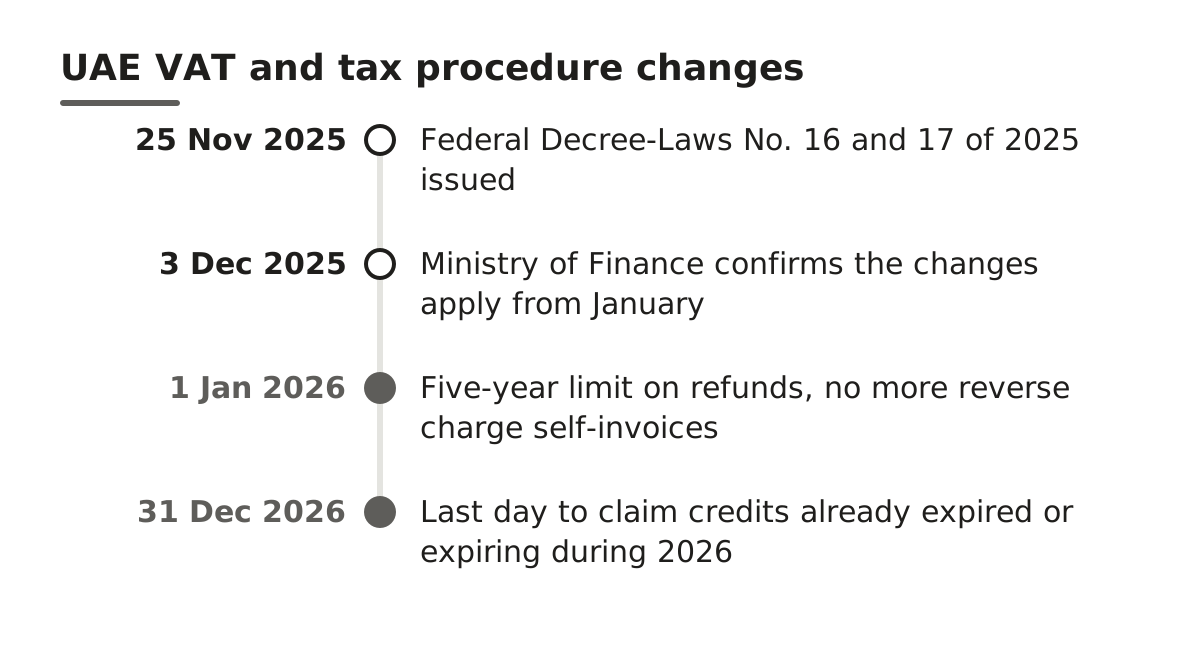
From 1 January 2026, UAE VAT credits come with an expiry date. Federal Decree-Law No. 16 of 2025, which amends the VAT Law, and Federal Decree-Law No. 17 of 2025, which amends the Tax Procedures Law, were issued on 25 November 2025. The Ministry of Finance has confirmed that both apply from 1 January 2026. The changes reach every business registered for UAE VAT.
Three changes matter most. Excess input VAT can only be carried forward or refunded for five years. Businesses no longer issue self-invoices under the reverse charge. And the Federal Tax Authority (FTA) gets an express power to deny input tax on purchases tied to tax evasion. There’s also a one-year window, ending 31 December 2026, to rescue old credits that would otherwise be lost.
What changed
A five-year limit on excess input VAT
Under the amended Article 74 of the VAT Law, excess recoverable VAT can be carried forward for a maximum of five years from the end of the tax period in which it arose. The amended Tax Procedures Law sets a matching five-year deadline for asking the FTA for a refund of a credit balance, or for using it to pay other tax. Once the five years are up, the right to reclaim is gone.
Until now, plenty of businesses simply left credits sitting on their FTA account, sometimes for years. That habit now has a cost.
A one-year rescue window for old credits
The Tax Procedures Law amendment includes a transitional rule. If your five-year period has already expired, or will expire within one year of the law taking effect, you can still ask for a refund or apply the balance against tax or penalties, as long as you do it within one year of 1 January 2026. In plain terms, the last day is 31 December 2026. KPMG notes that this reaches back to balances from 2018 to 2020.
No more self-invoices under the reverse charge
When you import goods or services and account for VAT under the reverse charge, you no longer have to issue a tax invoice to yourself. You do have to keep the supporting documents instead, such as the supplier’s invoice and the import documents, as set out in the Executive Regulation. It’s a small saving in admin, and a welcome one.
Input tax can be denied where a supply is linked to evasion
The FTA may now refuse input tax recovery where the supply formed part of a tax evasion arrangement and you knew, or should have known, about the link. DLA Piper points to the kinds of transactions that create risk: a supplier charging VAT where the reverse charge should apply, VAT charged on exempt or zero-rated supplies, VAT charged by a supplier that isn’t registered, and VAT charged on supplies outside the scope of VAT.
Other procedural changes
- The standard audit window is five years, with new exceptional cases where the FTA can go further back.
- Voluntary disclosures are now needed only in cases the FTA specifies. Other errors can be corrected through tax returns.
- The VAT Law’s own limitation provision has been repealed, so the time limits now come from the Tax Procedures Law.
Who this affects
- Businesses in a regular refund position: exporters, zero-rated suppliers, start-ups with heavy set-up costs, and anyone with large capital spending.
- Importers of services and goods who use the reverse charge, including UAE companies buying software, consulting or marketing from abroad.
- Foreign businesses registered for UAE VAT that have credit balances they’ve never claimed.
- Anyone buying from small or new suppliers, because the evasion rule puts more weight on your own checks.
What it means in practice
Take Harbor Line Logistics, a freight forwarder in Dubai with quarterly VAT periods. Most of its sales are zero-rated, so it has built up AED 240,000 of excess input VAT since 2019 and left it on its FTA account to offset future bills.
| Credit arose in | Five years end | What happens |
|---|---|---|
| Quarter ending 30 September 2019 | 30 September 2024 | Already expired, so it’s covered by the transitional window: claim by 31 December 2026 |
| Quarter ending 31 March 2021 | 31 March 2026 | Expires within a year of the new rules, so also covered: claim by 31 December 2026 |
| Quarter ending 30 June 2022 | 30 June 2027 | Normal rule applies: use or claim it before 30 June 2027 |
If Harbor Line does nothing in 2026, the older part of that AED 240,000 is gone for good. The fix is dull but effective: pull an ageing report of the credit balance by tax period, and file refund requests for anything that’s at risk.
The evasion rule works differently. Say a Sharjah contractor buys AED 400,000 of steel from a new supplier that charges AED 20,000 of VAT, and the supplier turns out not to be registered and never pays the tax over. If the FTA decides the contractor should have spotted it, the AED 20,000 input claim can be denied. A quick check of the supplier’s tax registration number before you pay would have been cheap insurance.
What to do now
- Age your VAT credit balance by the tax period it arose in, and flag anything from 2021 or earlier.
- File refund requests for at-risk credits well before 31 December 2026. Don’t leave it to the last week of the year.
- Stop issuing reverse charge self-invoices from January 2026, and make sure supplier invoices and import documents are filed where an auditor can find them.
- Add a supplier check to onboarding: confirm the TRN, and question VAT on invoices that should be reverse charged, zero-rated or exempt.
- Update your record-keeping policy for the five-year audit window.
- Diarize the new deadlines using our deadline calculator, and use the VAT calculator to double-check the tax on supplier invoices.
If you’re negotiating supply contracts, it’s also worth adding a clause that lets you hold back or recover VAT that the FTA disallows because of the supplier’s own failures. Our glossary entry on set-off explains how that kind of clause usually works, and the one on the statute of limitations covers the general idea behind time limits like these.
Sources
- UAE Ministry of Finance: Ministry of Finance to implement VAT Law amendments starting January 2026
- UAE Ministry of Finance: Amendments to the Tax Procedures Law starting early 2026
- KPMG: Federal Decree-Law No. 16 and 17 of 2025
- DLA Piper: UAE announces amendments to VAT Law effective 1 January 2026
This article is general information, not legal or tax advice. Laws differ between countries and states and change over time, so check the rules that apply to you or speak to a qualified professional.