VAT, GST and sales tax: how consumption taxes differ
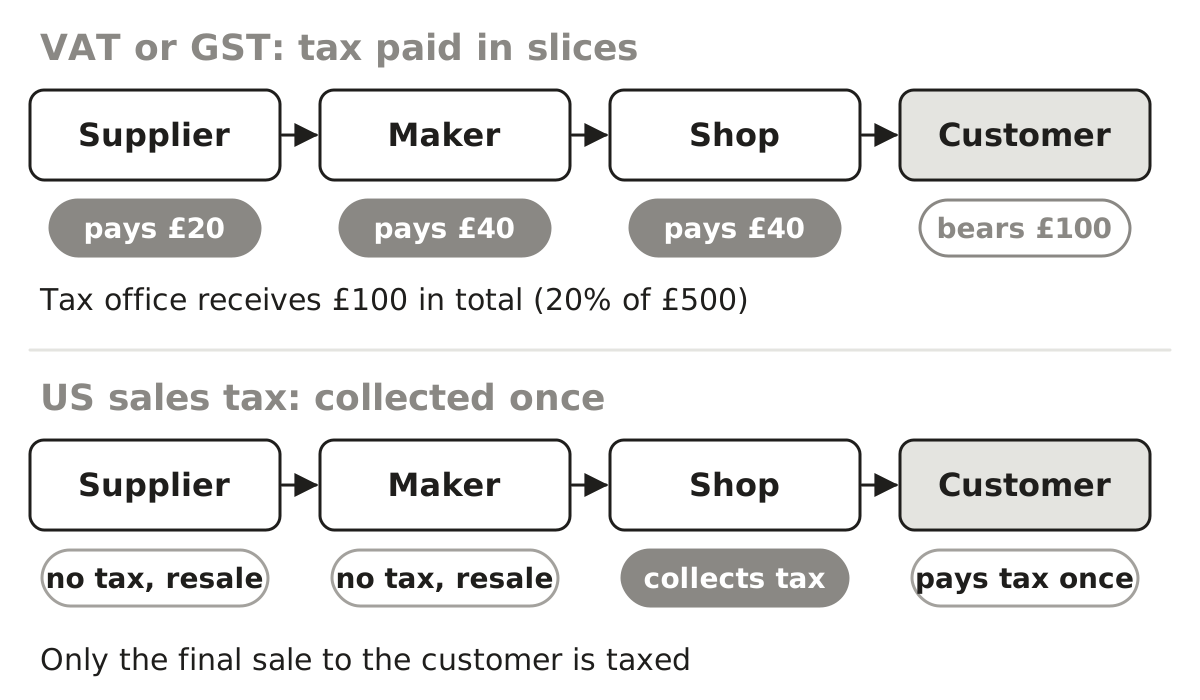
VAT, GST and sales tax are all taxes on consumption, and in every case the end customer carries the cost. The difference is where the tax gets collected. VAT (value added tax) and GST (goods and services tax) are charged at each stage of a supply chain, and every registered business claims back the tax it paid on its own purchases. US sales tax is charged once, when the product reaches the final buyer, and businesses buying for resale usually don’t pay it at all.
That sounds like accounting trivia. It isn’t. The system you fall under decides what goes on your invoices, when you have to register, and how much of your cash is sitting in tax at any given moment.
VAT and GST are basically the same tax
Different countries picked different names. The UK, the EU and the UAE call it VAT. Australia, New Zealand, Canada, Singapore and India call theirs GST. The mechanics are close enough that you can think of them as one system with local rates, thresholds and paperwork.
A registered business adds tax to its sales (output tax), pays tax on its purchases (input tax), and sends the difference to the tax authority each period. The tax is collected in slices along the chain. Because every business in the middle gets a credit, only the final consumer ends up out of pocket.
Take a furniture maker in Manchester. She buys £100 of timber and pays £20 VAT on it. She sells a table to a shop for £300 plus £60 VAT, then pays HMRC £40 (the £60 she charged minus the £20 she paid). The shop sells the table to a customer for £500 plus £100 VAT and pays HMRC £40 as well. HMRC collects £100 in total, which is exactly 20% of the final price. It just arrives in pieces.
How US sales tax works instead
The US has no national VAT. Most states, and many cities and counties, charge their own sales tax instead. As of 2025, 45 states and Washington, DC have a statewide sales tax. Alaska, Delaware, Montana, New Hampshire and Oregon don’t, though some Alaskan towns charge a local one.
Sales tax is a single-stage tax. The retailer collects it from the end customer and pays it to the state. A wholesaler selling to that retailer normally charges nothing, because the retailer hands over a resale certificate. There’s no credit system in the middle because, in theory, nothing gets taxed in the middle.
The catch shows up when a business buys things for its own use. A design studio in Austin buying a $3,000 laptop pays Texas sales tax on it and can’t claim it back. Under a VAT system, a registered business would usually recover that tax on its next return. That one difference changes how you budget for equipment.
The differences you’ll notice day to day
| VAT and GST | US sales tax | |
|---|---|---|
| Who charges it | Every registered business in the chain | Usually only the final seller |
| Tax on business purchases | Generally recoverable as an input tax credit | Usually a real cost, unless bought for resale |
| Rates | One national standard rate, plus reduced and zero rates | State rate plus local rates, set by thousands of jurisdictions |
| Services | Most services are taxed | Many services aren’t, and it varies by state |
| When you register | Once turnover passes a national threshold | Once you have nexus in a particular state |
| Your tax number on invoices | Required on a proper tax invoice | Not usually required |
Rates vary a lot. As of 2025, the UK standard rate is 20%, EU standard rates run from 17% in Luxembourg to 27% in Hungary, Australian GST is 10%, New Zealand’s is 15% and UAE VAT is 5%. Canada charges 5% federal GST, and some provinces combine it with their own tax into a single HST (13% in Ontario, for example). In the US, combined state and local rates go above 9% in some cities.
When you have to register
Under VAT and GST, registration is tied to turnover. As of 2025, the main thresholds look like this:
- UK: £90,000 of taxable turnover in any rolling 12-month period.
- Australia: A$75,000 of annual GST turnover.
- Canada: C$30,000 of taxable sales over four consecutive calendar quarters.
- UAE: AED 375,000 of taxable supplies for mandatory registration.
- EU: each country sets its own threshold, and in many of them a business based abroad has to register from its first taxable sale there.
US sales tax runs on a different trigger called nexus. You register in a state once you have a physical presence there or once your sales into that state pass its economic threshold, often $100,000 a year. A small online shop can end up registered in a dozen states without ever leaving home.
Honestly, many small businesses that sell mainly to other VAT-registered businesses do fine registering voluntarily before they hit the threshold. Your business customers can reclaim the VAT you charge, so it doesn’t make you more expensive to them, and you get to reclaim VAT on your own costs. Selling mostly to consumers is a different story, because the tax lands on them in full and your prices effectively go up.
Selling across borders
Cross-border sales are where the systems really split. A few patterns hold in most VAT countries:
- Exports of goods are usually zero-rated, so you don’t charge VAT but can still reclaim VAT on your costs.
- Business-to-business services sold across borders are often taxed where the customer is, using the reverse charge. You invoice without VAT and the customer accounts for it on its own return.
- Digital services to consumers are usually taxed at the customer’s rate. In the EU, the One Stop Shop lets you report all of these through a single registration.
In the US, there’s no border adjustment between states. You simply collect the destination state’s tax wherever you have nexus, and nothing where you don’t. The buyer is technically supposed to pay use tax in that case, though few individuals do.
What this means for your invoices and contracts
Get the tax line right and most of the other problems go away. A few habits help:
- Quote prices as “plus VAT” or “plus applicable sales tax” to business customers, and state it in the contract. A $5,000 fee that turns out to include tax means you’ve quietly given away the tax amount.
- Show your VAT or GST number on every invoice once you’re registered, and show the tax separately from the price.
- Keep resale and exemption certificates on file if you sell to US businesses without charging sales tax.
- Check the customer’s location and status (business or consumer) before you invoice, because both can change which rules apply.
Our free VAT calculator works out tax-inclusive and tax-exclusive prices at any rate, and the invoice generator puts the tax line in the right place. If you’re agreeing prices in a longer contract, read the payment clause for who bears tax and for payment terms at the same time.
Next steps
- Work out which system applies to each place you sell into, and write it down.
- Check your turnover against the threshold in your home country every month, not once a year.
- If you sell into the US, list the states where your sales are growing and check their nexus thresholds.
- Make sure every contract says whether prices include or exclude tax.
- Talk to an accountant before your first cross-border sale. One hour of advice is cheaper than unwinding a year of wrong invoices.
This article is general information, not legal or tax advice. Laws differ between countries and states and change over time, so check the rules that apply to you or speak to a qualified professional.