Who owns the work you paid for? Copyright and contractors
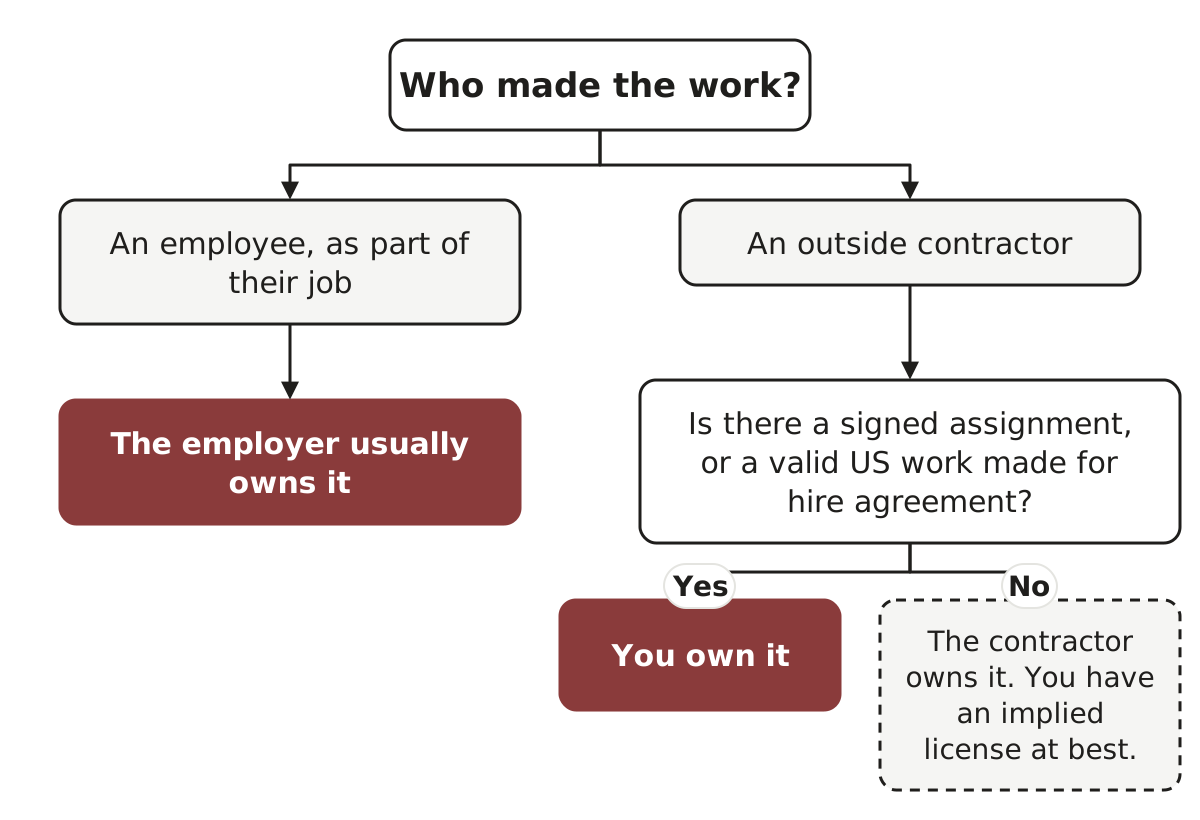
Usually, you don’t. In the US, the UK, the EU, Canada and Australia, copyright belongs to the person who created the work, and paying for it doesn’t change that. Unless your contractor signed a written assignment (or, in the US, a valid work-made-for-hire agreement), they still own the copyright and what you’ve really bought is permission to use it. The fix is a short clause, and it’s cheap if you sort it out before the work starts.
Paying for it isn’t the same as owning it
Picture a design studio in Austin that pays a freelance illustrator $4,800 for a set of product illustrations. The invoice gets paid, the files arrive, everyone’s happy. Nothing in the email thread mentions copyright, so the illustrator still owns it. The studio has a license to use the drawings for the job they were made for, and not much more.
Most of the time nobody notices. The trouble comes later, when you want to put those illustrations on merchandise, stop a competitor copying them, or satisfy an investor’s lawyer who wants proof that the company owns its brand assets. “We paid for them” isn’t proof.
Employees are different. When an employee creates something as part of their job, the employer generally owns it automatically. Contractors don’t get that treatment, even if they’ve worked for you three days a week for a year.
How the defaults compare by country
The details vary, but the pattern holds almost everywhere you’re likely to hire.
| Where | Employee, work done as part of the job | Contractor, no written agreement |
|---|---|---|
| United States | Employer owns it as a work made for hire | Contractor owns it |
| United Kingdom | Employer owns it, unless agreed otherwise | Contractor owns it; the client usually gets an implied license |
| Canada and Australia | Employer generally owns it | Contractor generally owns it |
| EU countries | Varies; in some, the employer gets rights of use rather than ownership | Contractor owns it; some countries don’t allow copyright to be transferred at all |
One catch. Whether someone is really an employee or an independent contractor is decided on the facts, not the job title in the contract. Don’t count on the employee rule to rescue you. Put ownership in writing.
“Work made for hire” is a US idea, and a narrow one
Lots of US contracts say the work is a work made for hire. For a contractor, that label only does anything if two things are true. The work has to fit one of nine categories in the federal Copyright Act, and both sides have to sign a written agreement saying it’s a work made for hire.
The nine categories are a contribution to a collective work, part of a motion picture or other audiovisual work, a translation, a supplementary work, a compilation, an instructional text, a test, answer material for a test, and an atlas. Look at what’s missing: software, logos, photos for your website, most marketing copy. For the things small businesses commission most often, a work-for-hire clause on its own may transfer nothing.
That’s why well-drafted contracts say the work is made for hire “to the extent permitted by law” and then add a backup assignment of everything else. In California there’s an extra wrinkle, because a work-made-for-hire clause with an individual can have employment law side effects, so many businesses there use a plain assignment instead. If you hire individuals in California, check this before reaching for a template.
Outside the US, the phrase has no special meaning. In the UK, Canada or Australia you need an assignment.
What a good assignment clause says
An IP assignment is a written transfer of ownership from the creator to you. In most countries it has to be in writing and signed by the person giving up the rights. When we review these clauses, these are the points we check first.
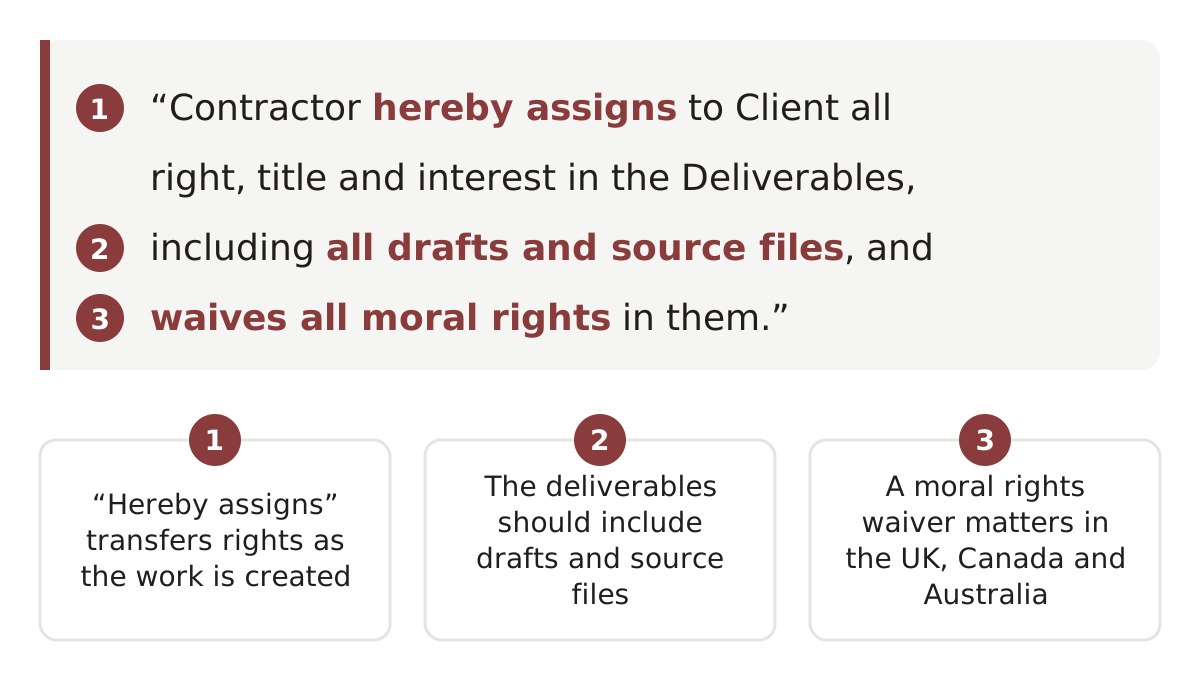
- “Hereby assigns,” not “agrees to assign.” The first transfers rights as the work is created. The second is only a promise to transfer later, and promises can be broken.
- Everything, drafts included. Define the deliverables to include drafts, source files, code, layered artwork and documentation.
- All IP rights. Copyright, plus designs, inventions and database rights where they’re relevant.
- Moral rights. In the UK, Canada and Australia, moral rights (like the right to be credited) can’t be assigned, but the creator can usually waive them or consent to what you plan to do. Ask for that.
- Further assurances. A promise to sign any paperwork you need later to register or enforce your rights.
- A carve-out for their existing tools, paired with a license for you to use them. More on that below.
Continental Europe needs extra care. In Germany, copyright itself can’t be transferred during the author’s lifetime, so contracts grant exclusive, unlimited rights of use instead. In France, moral rights can’t be waived. A clause written for Texas won’t do what you expect in Munich.
If you’re starting from scratch, the contractor agreement template and the IP assignment template give you basic wording to adapt to where your contractor is based.
Their tools, your deliverables
Freelancers don’t start from a blank page. A developer in Manchester might bring a library of code she’s refined over eight years and reuses on every project. She won’t hand that over to each client, and she shouldn’t have to.
The usual split is fair to both sides. You own everything created specifically for you. She keeps her background materials and gives you a perpetual, royalty-free license to use them as part of what she delivered. Third-party material (stock photos, fonts, open source code) gets listed so you can check its terms yourself.
- Ask the contractor to list any pre-existing or third-party material they plan to use.
- Make sure stock images and fonts are licensed for commercial use in your business’s name, not the freelancer’s account.
- For software, ask which open source components are included and under which licenses.
- On bigger projects, get a promise that the work doesn’t infringe anyone else’s rights, backed by an indemnity.
If you’ve already paid and there’s no contract
You’re not necessarily stuck. Courts in the US, the UK and elsewhere often find that a client has an implied license to use commissioned work for the purpose it was made for. Paid $2,500 for a website design? You can almost certainly use it as your website.
An implied license is thin protection, though. It might not be exclusive, so the designer could sell something very similar to someone else. It might not let you change the work or use it for something new. And it looks weak when a buyer or investor starts asking questions.
The clean fix is a confirmatory assignment: a one-page document where the creator confirms they assign all rights in the work to you, effective from when it was made. Most freelancers will sign one if you ask politely and explain why, especially with a modest payment attached. Even $100 helps show the transfer was supported by something of value, which matters in some countries.
What to do this week
- List the assets your business actually depends on: code, logo, website, product designs, photos, written content.
- Next to each one, write who made it and whether there’s a signed document transferring ownership.
- Where there’s a gap, ask for a confirmatory assignment now, while the relationship is good. It’s much harder after a falling out.
- For new projects, put the ownership clause in the contract before work starts. Not in the final invoice, and not in an email afterwards.
- Check the governing law and where the contractor lives, since local rules on moral rights and transfers can override your template.
If you’ve got a folder of old contractor agreements, you can check them for missing or weak ownership clauses with LegalWolf.
This article is general information, not legal or tax advice. Laws differ between countries and states and change over time, so check the rules that apply to you or speak to a qualified professional.