Canada’s tax reversals: capital gains, the DST and a 14% bottom rate
Canada’s federal tax picture has changed a lot in a year, mostly by things being taken away. The proposed increase in the capital gains inclusion rate was cancelled in March 2025, so gains are still taxed at a one-half inclusion rate. The 3% digital services tax (DST) was rescinded in June 2025, and the repeal became law on March 26, 2026, backdated to the tax’s original enactment, with refunds and interest for anyone who paid. And the lowest federal personal income tax rate fell from 15% to 14% from July 1, 2025. If you own a business, sell investments or property, or advise people who do, all three matter.
What changed
The capital gains inclusion rate stays at one-half
The 2024 federal budget had proposed raising the inclusion rate from one-half to two-thirds for capital gains above $250,000 a year for individuals, and on all capital gains for corporations and most trusts. On January 31, 2025, the government pushed the start date back to January 1, 2026. Then on March 21, 2025, Prime Minister Mark Carney announced the increase was cancelled altogether. The Canada Revenue Agency went back to administering the enacted one-half rate.
One part of the package survived: the higher lifetime capital gains exemption of $1.25 million on the sale of qualifying small business shares and farming and fishing property.
The digital services tax is gone, retroactively
The DST applied to large digital businesses. On June 29, 2025, the day before the first payments were due, the Department of Finance announced it would rescind the tax to move trade talks with the United States forward, and said collection on June 30 would be halted. The repeal legislation received Royal Assent on March 26, 2026 as part of Bill C-15, the Budget 2025 Implementation Act, No. 1. The repeal reaches back to June 20, 2024, the date the tax was first enacted.
According to the CRA, businesses that paid will get their money back with interest, at the rate generally used for corporate tax refunds, from the date the CRA received the payment. DST program accounts are closed automatically, and no action is needed from the business. Refunds over $25 million require contacting the CRA to arrange payment.
The lowest personal rate is now 14%
The rate on the lowest federal bracket dropped from 15% to 14% effective July 1, 2025. Because it started halfway through the year, the full-year rate for 2025 is 14.5%, and it’s 14% for 2026 and later years. Finance says the cut is worth up to $420 per person and $840 for a two-income family in 2026. The rate for most non-refundable tax credits stays tied to the lowest rate.
Who it affects
- Individuals with large gains, such as people selling a cottage, rental property or an investment portfolio.
- Holding companies and trusts, which would have faced the two-thirds rate on every dollar of gain.
- Business owners planning a sale, who keep the $1.25 million lifetime exemption on qualifying shares.
- Large digital groups that registered for and paid the DST.
- Almost every employee and self-employed person, through the lower bottom rate.
Key dates
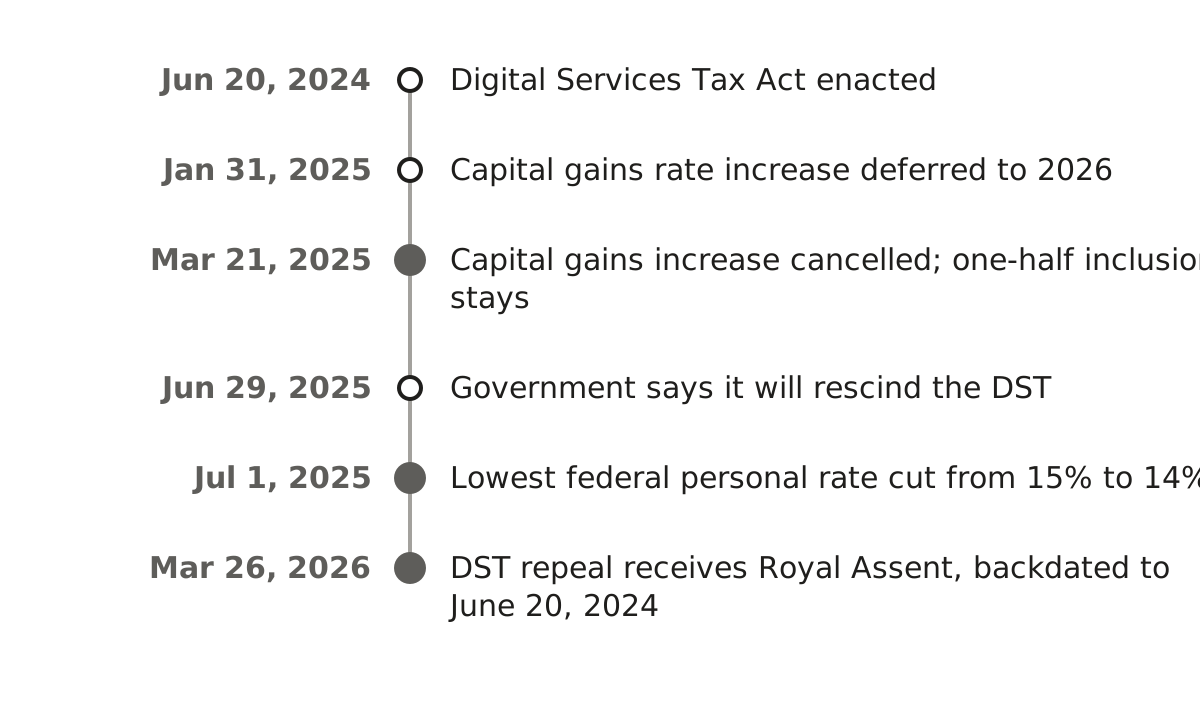
| Date | Event |
|---|---|
| June 20, 2024 | Digital Services Tax Act enacted (now the date the repeal reaches back to) |
| January 31, 2025 | Capital gains inclusion rate increase deferred to January 1, 2026 |
| March 21, 2025 | Capital gains increase cancelled |
| June 29, 2025 | Government announces the DST will be rescinded |
| July 1, 2025 | Lowest federal personal rate falls to 14% |
| March 26, 2026 | DST repeal receives Royal Assent |
What it means in practice
Marc, an Ottawa consultant, sells a rental condo in 2026 and realizes a $400,000 capital gain. At the one-half inclusion rate, $200,000 goes into his taxable income. Under the cancelled proposal, the first $250,000 would have been included at one-half ($125,000) and the other $150,000 at two-thirds ($100,000), for $225,000. The cancellation keeps $25,000 out of his taxable income.
His holding company is a starker case. On a $100,000 corporate gain, one-half inclusion means $50,000 of taxable income. The proposal would have made it about $66,667, because the $250,000 annual threshold was never available to corporations.
Some people sold assets in 2024 to get ahead of the change. Some of those sales made sense anyway. Others were driven by a rule that never took effect, and the tax paid early can’t be undone. The lesson I’d take from this: don’t restructure around a proposal until it’s law, unless the deal makes sense on its own.
What to do now
- If you deferred a sale waiting for clarity, run the numbers again at one-half inclusion.
- If you’re selling qualifying small business shares, check eligibility for the $1.25 million lifetime exemption early, since the conditions take time to meet.
- If your group paid the DST, confirm the CRA has your current banking and contact details, and contact the CRA if your refund is over $25 million.
- Check payroll and instalments. Employers were told to use updated source deduction tables from July 1, 2025, and self-employed people may be able to lower 2026 instalments.
- Look at existing contracts with digital platforms. If a supplier passed the DST through to you, your agreement may say whether you share in the refund.
For a general primer on sales taxes, including Canada’s GST and HST, see our guide to VAT, GST and sales tax. As of April 2026, all three changes are settled law.
Sources
- Prime Minister of Canada: Carney cancels proposed capital gains tax increase
- Canada Revenue Agency: Update on administration of the proposed capital gains changes
- Government of Canada: Digital services tax repealed
- Department of Finance Canada: Canada rescinds digital services tax
- Department of Finance Canada: Delivering a middle-class tax cut
This article is general information, not legal or tax advice. Laws differ between countries and states and change over time, so check the rules that apply to you or speak to a qualified professional.