EU pay transparency: the deadline passed, most countries are late
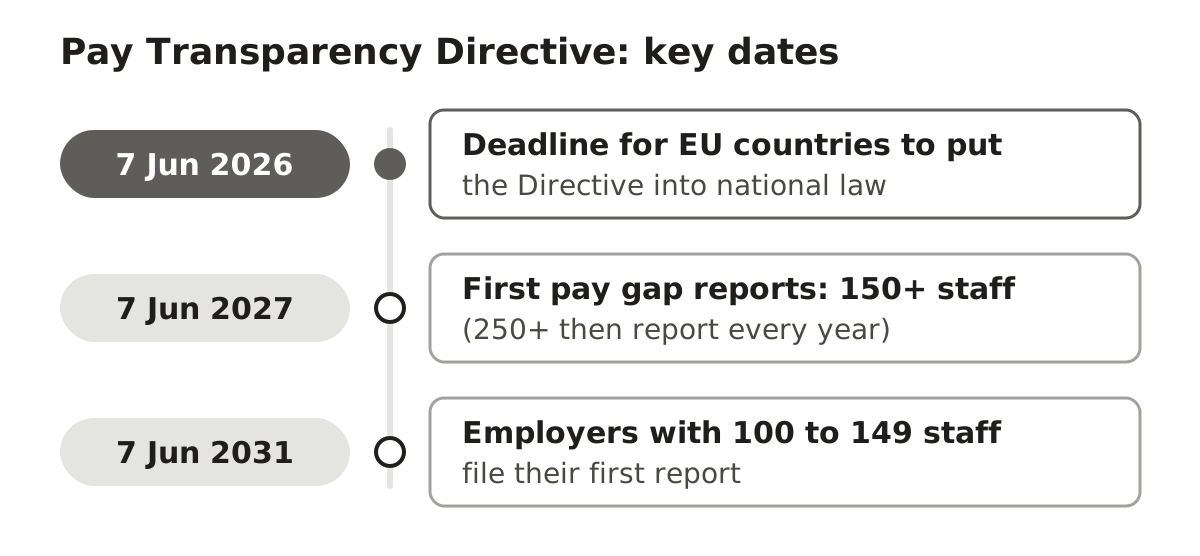
The deadline for EU countries to put the Pay Transparency Directive (EU) 2023/970 into national law was 7 June 2026. As of late September 2026, most of them have missed it. Trackers count only a handful of full transpositions: Slovakia, Italy, Lithuania and Malta. Several more countries have partial laws, and big employment markets such as Germany, France, the Netherlands and Ireland are still working on their bills.
The Commission has refused to extend the deadline. For employers, that means the rules are arriving country by country over the next year or so, on slightly different timetables. The content, though, is largely fixed by the Directive, so there’s no reason to wait for your national law to start preparing.
What the Directive requires
The Commission’s June 2026 explainer sums up the core duties. Once your country has transposed the Directive:
- Pay ranges before the interview. Job applicants must be told the starting pay or pay range for the role, either in the job advert or before the interview.
- No pay history questions. You can’t ask candidates what they earn now or earned in past jobs.
- A right to information. Workers can ask in writing for their own pay level and the average pay, broken down by sex, of people doing the same work or work of equal value. The Directive gives employers two months to answer.
- No pay secrecy clauses. Contract terms that stop workers from disclosing their pay aren’t allowed for the purpose of enforcing equal pay.
- Clear criteria. The criteria used to set pay and progression must be available to workers.
- Burden of proof. In an equal pay dispute, the burden shifts to an employer that hasn’t met its transparency duties.
Pay gap reporting
Employers with 100 or more workers also have to report their gender pay gap. The first reporting dates are fixed in the Directive:
| Number of workers | First report | After that |
|---|---|---|
| 250 or more | 7 June 2027 | Every year |
| 150 to 249 | 7 June 2027 | Every three years |
| 100 to 149 | 7 June 2031 | Every three years |
If a report shows a gap of 5% or more in any category of workers that you can’t justify on objective, gender-neutral criteria, and you don’t fix it within six months, you have to carry out a joint pay assessment with worker representatives.
Where each country stands, as of September 2026
Trackers don’t all agree, so treat this as a snapshot:
- Fully transposed: Slovakia, Italy (Legislative Decree 96/2026), Lithuania and Malta. One law firm counts Lithuania as only partial.
- Partial: Greece (its main duties apply from 1 November 2026), Estonia and Belgium (only the French Community so far). Belgium asked the Commission for a six-month extension in June.
- Netherlands: a bill was filed on 21 May 2026 aiming at 1 January 2027, but with plenary debates set for December and January, Dutch payroll press expects 1 July 2027.
- Germany: no bill adopted yet. Reports differ on when the cabinet will approve it.
- France: a draft was amended in September 2026, with the aim of a final vote before the spring 2027 presidential election.
- Ireland: the bill didn’t get priority drafting status in the autumn legislative programme.
- Others: Czechia, Denmark, Finland, Spain, Portugal, Austria and Poland all have drafts at various stages. Sweden said in March 2026 it wouldn’t transpose because it considers the rules too burdensome.
Until a country acts, employees generally can’t sue their employer directly under the Directive. But the obligations will arrive, and some national laws may apply them with little notice.
What it means in practice
Take Nordlicht Software, an Amsterdam company with 180 staff. It’s in the 150 to 249 band, so under the Directive its first pay gap report is due by 7 June 2027, and then every three years. The Dutch law may only start in mid-2027, which leaves very little runway. Nordlicht also hires steadily, so the pay range and pay history rules will change its recruitment process the day the Dutch law takes effect.
Its HR lead would be wise to run a private pay gap analysis now. If the numbers show a 7% gap in its engineering grades, it has time to find the cause and fix it before the first report goes public. If it waits, it may be reporting a gap it can’t explain and heading straight into a joint pay assessment.
Non-EU companies with staff in the EU aren’t exempt. The duties fall on the employer of workers in each member state, whoever owns the business.
What to do now
- Count your workers in each EU country and work out which reporting band you’re in.
- Put pay ranges on your job adverts and remove pay history questions from application forms and interview scripts.
- Write down your pay-setting and progression criteria in gender-neutral terms.
- Run a confidential pay gap analysis by category of worker, and look hard at anything over 5%.
- Check your contracts for pay secrecy clauses and your employee handbook for anything that discourages pay discussions.
- Track the national law in each country where you employ people, since dates and details will differ.
Sources
- European Commission: new EU rules on pay transparency explained
- EUR-Lex: Directive (EU) 2023/970 on pay transparency
- Ius Laboris: which countries have transposed the Directive
- Morgan Lewis: the transposition deadline has passed, what now
- Salaris Vanmorgen: Dutch pay transparency law later than 1 January 2027
This article is general information, not legal or tax advice. Laws differ between countries and states and change over time, so check the rules that apply to you or speak to a qualified professional.