France’s e-invoicing reform went live on 1 September 2026
France’s e-invoicing reform started on 1 September 2026, on schedule. From that date, every business established in France and subject to VAT has to be able to receive invoices from other French businesses as structured e-invoices, through a plateforme agréée (an approved platform, or PA). Large companies and mid-size companies (ETIs, in French terms) also have to issue their B2B invoices that way and send transaction data to the tax authority. Small and medium businesses, including micro-businesses and most freelancers, keep sending ordinary invoices until 1 September 2027.
The government has also said there will be no penalties for any business in 2026. That’s a real concession, but it isn’t a delay. The legal calendar hasn’t moved, and the fines written into the 2026 Finance Law are waiting for 2027.
What changed on 1 September
Before September, a French supplier could email a PDF invoice and call it a day. Under the new system, invoices between French VAT-registered businesses travel as data, from the supplier’s platform to the customer’s platform, with key fields copied to the tax authority (DGFiP) along the way.
- Approved platforms do the work. The DGFiP registers each platform for three years, renewable. A platform issues, transmits and receives e-invoices, and it sends invoice data and payment data to the tax authority.
- The public platform is now a directory, not an invoicing tool. The state platform (PPF) acts as the central directory that tells senders where each business receives its invoices, and as the hub that collects data for the tax authority. Businesses have to pick a private approved platform to actually send and receive.
- A PDF is no longer enough. An e-invoice has to be in a structured format. In practice the platforms work with Factur-X, UBL and CII.
- Four new invoice details. Invoices now need the customer’s SIREN number, the delivery address where it differs from the billing address, whether the sale is goods, services or both, and, where it applies, the note that VAT is paid on a debit basis (option pour les débits).
- E-reporting for everything else. Sales to consumers and international transactions aren’t e-invoiced, but their data still has to be reported to the tax authority through the platform. That’s called e-reporting, and it also covers payment data.
The minister’s launch press release said more than 4 million businesses had already registered a receiving address and that 66% of the core target group had chosen a platform. So a third of that group still hadn’t, on day one.
Who it affects
The mandate covers purchases and sales of goods and services between businesses established in France and subject to VAT. The government’s business portal says transactions with consumers and with foreign customers sit outside e-invoicing, though they fall under e-reporting.
- Large companies and ETIs: receive, issue and e-report from 1 September 2026.
- SMEs and micro-businesses: receive from 1 September 2026, issue and e-report from 1 September 2027.
- Freelancers and sole traders: they’re businesses for these purposes, so they must be able to receive now, even if they’re in the small-business VAT exemption, and they issue from 2027.
- Businesses outside France: if you sell to French companies from abroad, the domestic e-invoicing mandate isn’t aimed at you. Your French customers are the ones reporting data on those purchases, so expect them to ask for cleaner, more complete invoice details.
Key dates
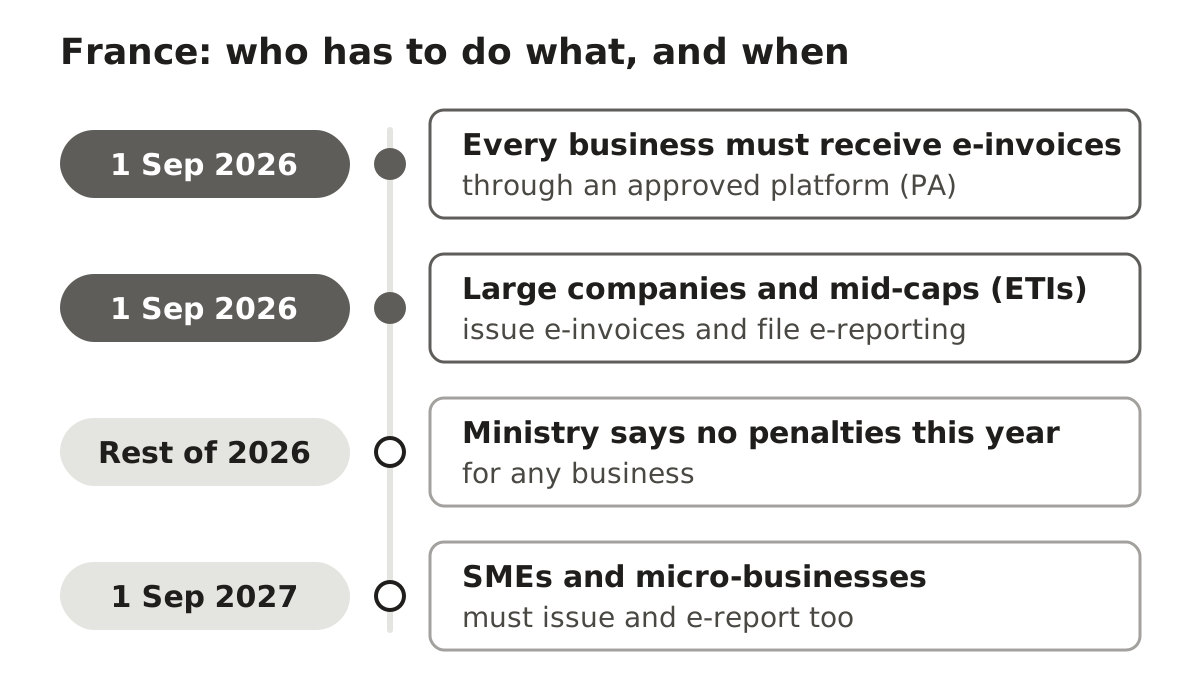
| Date | What happens |
|---|---|
| 1 September 2026 | All in-scope businesses must receive e-invoices through an approved platform. Large companies and ETIs issue and e-report. |
| Rest of 2026 | The ministry says no penalties will be applied to any business this year. |
| 1 September 2027 | SMEs and micro-businesses must issue e-invoices and e-report. |
The penalties waiting for 2027
The 2026 Finance Law (Law No. 2026-103 of 19 February 2026) raised the fines. Under the current text of the General Tax Code:
- Failing to issue an invoice as an e-invoice costs €50 per invoice, capped at €15,000 a year. The old figure was €15.
- A business that doesn’t have an approved platform to receive invoices gets a formal notice and three months to fix it. After that, the fine is €500, then €1,000 for each further three months it stays out of line.
- E-reporting failures cost €500 per transmission, capped at €15,000 a year. There’s no fine for a first slip in the current year or the three before it if you correct it yourself or within 30 days of being asked.
One thing to watch: Legifrance lists the current versions of these penalty articles as valid only until 1 January 2027. That usually means another amendment is already scheduled, and as of September 2026 we couldn’t find a clear explanation of what replaces them. Check the text again in January before you rely on these numbers.
What it looks like in practice
Take Atelier Morel, a Lyon design studio with 12 staff and €1.8 million of turnover. It’s an SME, so it’s in the 2027 group for issuing. But its biggest supplier, a software company that counts as an ETI, now has to send Atelier Morel e-invoices. If Atelier Morel hadn’t picked a platform and registered a receiving address, that supplier’s invoices would have nowhere to go. So the studio needed a platform on 1 September 2026 even though it won’t issue a single e-invoice for another year.
Now fast forward to autumn 2027. Suppose Atelier Morel carries on emailing PDFs to its French clients, around 400 invoices a year. At €50 an invoice that’s €20,000, but the cap limits it to €15,000 under the current text. Paying for a platform is a lot cheaper than that.
My honest view: the no-penalty year is useful breathing room for fixing data quality, not a reason to wait. The businesses that struggle in 2027 will be the ones whose customer records don’t have SIREN numbers and whose invoice templates don’t separate goods from services.
What to do now
- Confirm you’ve chosen an approved platform and that your receiving address shows in the directory.
- Work out which group you’re in (large, ETI, SME or micro) and write down your issuing date.
- Add the four new details (customer SIREN, delivery address, goods or services, debit option) to your invoice templates and customer records.
- List your B2C and cross-border sales, because they fall under e-reporting rather than e-invoicing.
- Test a few invoices end to end with your biggest customers and suppliers before the 2027 deadline, not after.
- Recheck the penalty articles in January 2027, since the current versions run only to that date.
If you’re tidying up your templates anyway, our guide to a valid tax invoice covers the basics, and the invoice generator is handy for non-French invoices that still go out as PDFs.
Sources
- Ministry of the Economy: e-invoicing launch press release, 1 September 2026
- Entreprendre.Service-Public: e-invoicing, be ready for 1 September 2026
- impots.gouv.fr: e-invoicing and approved platforms
- DGFiP: practical guide to e-invoicing
- Legifrance: General Tax Code, article 1737
This article is general information, not legal or tax advice. Laws differ between countries and states and change over time, so check the rules that apply to you or speak to a qualified professional.