Germany’s e-invoice rules: issuing becomes mandatory from 2027
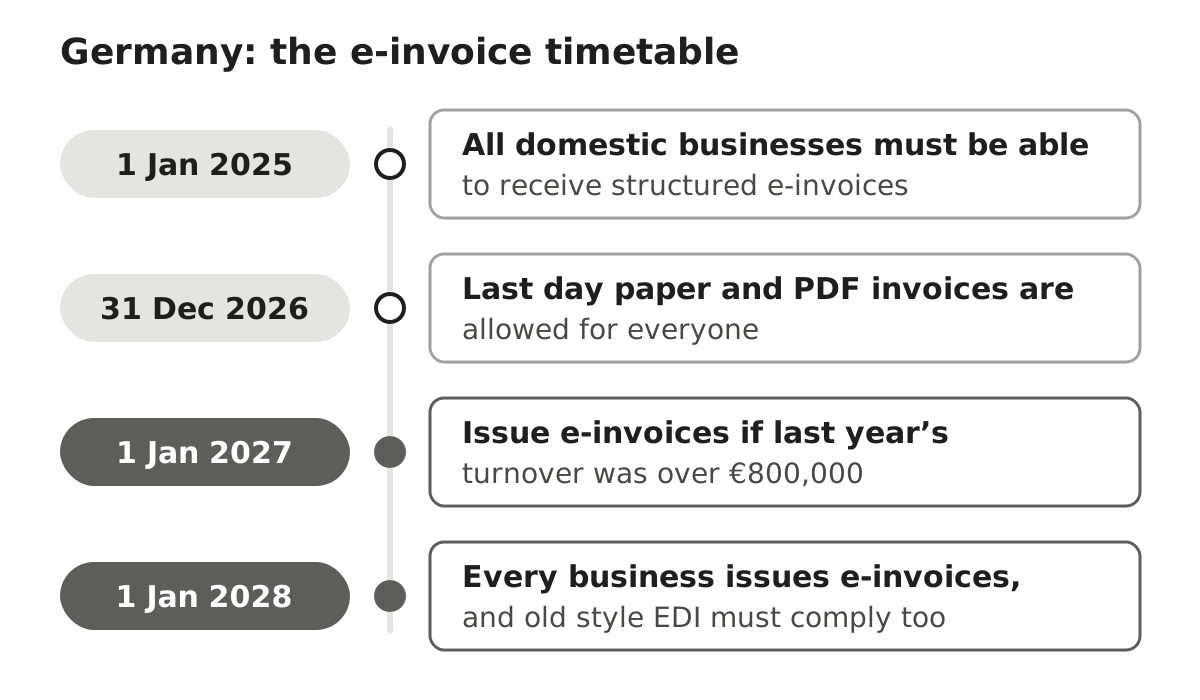
Germany’s move to mandatory B2B e-invoicing is now halfway through. Since 1 January 2025, every business established in Germany has had to be able to receive structured e-invoices from other German businesses. The next step comes on 1 January 2027, when businesses whose turnover in the previous year was over €800,000 must start issuing them. From 1 January 2028, everyone else follows, and the last transitional exceptions end.
On 15 October 2025 the Federal Ministry of Finance (BMF) published a second guidance letter. It amends and adds to the original letter of 15 October 2024 rather than replacing it, so you need both. As of October 2025, neither the law nor the guidance has moved the dates.
What counts as an e-invoice
This is where people trip up. In German VAT law, an “e-invoice” is a structured electronic invoice that meets the European standard EN 16931, so software can read it without a human. The formats businesses use in practice are XRechnung and ZUGFeRD (from version 2.0.1, except the MINIMUM and BASIC-WL profiles). A plain PDF, even one sent by email, is now an “other invoice” (sonstige Rechnung), not an e-invoice.
The obligation covers domestic B2B supplies where both supplier and customer are established in Germany. A few things sit outside it:
- Sales to consumers.
- Small invoices of up to €250 gross.
- Travel tickets.
- Certain VAT-exempt supplies (those under section 4 nos. 8 to 29 of the VAT Act).
For receiving, the BMF guidance says an email inbox is enough. You don’t need a special portal. What you do need is a way to read, check and archive the structured file, because the XML is the invoice, not the pretty picture some tools show alongside it.
The October 2025 letter adds detail on errors. It separates format errors, where the file isn’t a valid e-invoice at all, from breaches of the standard’s business rules, and it explains how each one affects the invoice. If your accounts team rejects invoices by hand today, this is the part of the letter worth reading closely.
The transition rules
The dates come from section 27(38) of the VAT Act (UStG):
- Until 31 December 2026: any business may still issue paper invoices, or other electronic formats such as PDFs if the customer agrees.
- During 2027: that option stays open only for businesses whose total turnover in the previous calendar year was no more than €800,000.
- Until 31 December 2027: invoices sent by EDI under the older EU recommendation are still allowed, even if they don’t meet EN 16931.
- From 1 January 2028: every in-scope B2B invoice must be a proper e-invoice.
Who it affects
Every business established in Germany that sells to other German businesses. That includes freelancers and small firms, even the ones using the small-business VAT scheme, because they all have to be able to receive. Businesses outside Germany with no establishment there aren’t caught by the German issuing obligation for their cross-border sales, but if you have a German branch, it’s in.
The turnover test is backward-looking. For 2027, what matters is your total turnover in 2026. That catches out businesses that grow fast. A company that crosses €800,000 during 2026 is in the 2027 group, even if it was well under the line the year before.
A worked example
Two businesses in Freiburg:
- Schreinerei Vogel, a joinery with €650,000 of turnover in 2026. It can keep sending paper or PDF invoices (the PDF with the customer’s agreement) throughout 2027. It must issue e-invoices from 1 January 2028.
- Kraus IT GmbH, a software consultancy with €1.2 million of turnover in 2026. From 1 January 2027, every invoice it sends to a German business customer must be an XRechnung, a compliant ZUGFeRD file or another EN 16931 format. A PDF invoice sent in February 2027 wouldn’t be a valid e-invoice.
Both of them already have to accept e-invoices from their suppliers, and have since January 2025. If Kraus IT’s accounting software can’t read an XRechnung file properly, that’s a problem today, not in 2027.
My advice to smaller firms like Vogel: don’t wait for 2028. Your bigger customers will start asking for e-invoices in 2027 anyway, because it makes their own processing easier, and most accounting packages already support the formats.
What to do now
- Check your 2025 and expected 2026 turnover against the €800,000 line so you know whether you’re in the 2027 or 2028 group.
- Confirm your accounting software can create, read and archive XRechnung and ZUGFeRD files.
- Make sure your archiving keeps the structured file itself, not just a PDF view of it.
- Ask your top customers which format and delivery channel they want.
- If you still use older EDI connections, plan to move them onto an EN 16931 format before the end of 2027.
- Read the 15 October 2025 BMF letter alongside the 2024 one, particularly the part on errors.
For the basics of what any VAT invoice has to show, see our guide to a valid tax invoice. The VAT calculator helps with the numbers.
Sources
- Gesetze im Internet: section 27 of the German VAT Act (UStG)
- Federal Ministry of Finance: BMF letter of 15 October 2025 on mandatory e-invoicing
- IHK Munich: electronic invoices guide
This article is general information, not legal or tax advice. Laws differ between countries and states and change over time, so check the rules that apply to you or speak to a qualified professional.