Mexico cuts the workweek to 40 hours: the 2027 to 2030 schedule
Mexico is shortening its legal workweek from 48 hours to 40, two hours at a time, starting on January 1, 2027. The constitutional amendment was published in the Diario Oficial de la Federación (DOF) on March 3, 2026, and the matching changes to the Federal Labor Law (Ley Federal del Trabajo) were published on May 1, 2026 and took effect that day. Pay and benefits can’t be reduced because of the shorter week. Employers also have to keep an electronic record of each worker’s start and finish times. If you employ people in Mexico, directly or through a subsidiary, you have the rest of 2026 to get ready.
What changed
The schedule
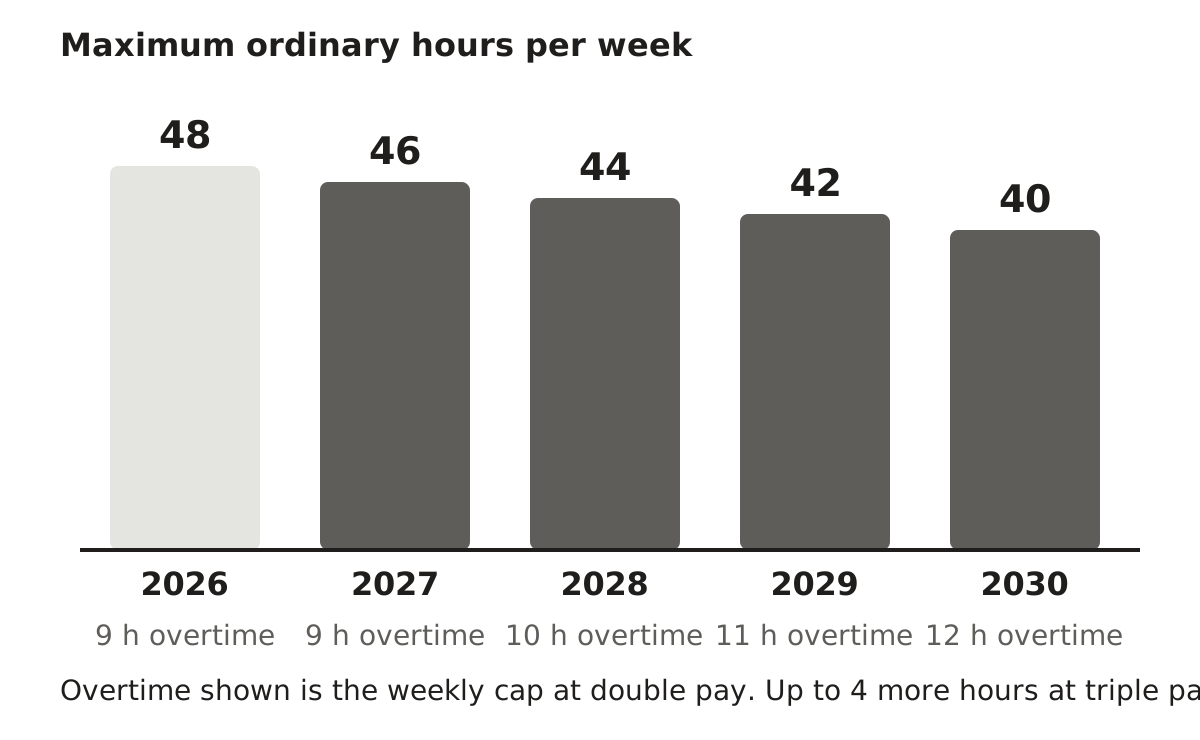
The ordinary workweek stays at 48 hours in 2026 and then falls by two hours on January 1 of each year:
- 2027: 46 hours
- 2028: 44 hours
- 2029: 42 hours
- 2030: 40 hours
The labor law reform calls May 1 to December 31, 2026 an adjustment period for employers and workers to adapt their processes. The rule of one full paid rest day for every six days worked hasn’t changed.
No pay cuts
Both the constitution and the labor law say the reduction can’t lead to lower salaries, wages or benefits. In practice, a worker paid a weekly salary keeps that salary while working fewer hours, so the effective hourly cost goes up.
Overtime limits
The labor law’s transitional rules cap weekly overtime at 9 hours in 2026 and 2027, 10 in 2028, 11 in 2029 and 12 in 2030. According to Holland & Knight and Baker McKenzie, those are the hours paid at double rate, with up to 4 more hours a week paid at triple rate. The Ministry of Labor (STPS) describes the end state as up to 12 hours at double pay and four at triple. Overtime can be spread over up to four hours a day on no more than four days a week, total daily hours can never go above 12, and minors can’t work overtime at all.
Electronic time records
A new obligation in article 132 of the Federal Labor Law requires every employer to record each worker’s working hours electronically, including start and end times, and give the record to the labor authorities on request. The STPS is to issue general rules on how the system must work, and those rules take effect on January 1, 2027. Fines for failing to keep the record range from 250 to 5,000 UMA (Mexico’s unit of measure for fines). As of May 2026, the STPS hasn’t published those rules, so the technical details are still pending.
Who it affects
- Manufacturers and maquiladoras running six-day, 48-hour shift patterns.
- Retail, hospitality and logistics businesses with long opening hours.
- Foreign companies with Mexican subsidiaries, nearshoring plants or staff hired through local entities.
- Office employers, less so. Many office staff already work 40 hours or less, but the time-recording duty applies to everyone.
Key dates
| Date | What happens |
|---|---|
| March 3, 2026 | Constitutional amendment published in the DOF |
| May 1, 2026 | Federal Labor Law reform published and in force; adjustment period starts |
| January 1, 2027 | Workweek falls to 46 hours; STPS rules on electronic time records take effect |
| January 1, 2028 | 44 hours |
| January 1, 2029 | 42 hours |
| January 1, 2030 | 40 hours |
What it means in practice
Take a parts plant in Monterrey with 120 production workers on six eight-hour shifts, each earning MXN 2,400 a week. That’s MXN 50 an hour at 48 hours.
In 2027 the ordinary week is 46 hours, and the weekly pay stays at MXN 2,400. The effective hourly rate rises to about MXN 52.17. If the plant keeps everyone on 48 hours, the last two hours each week count as overtime at double rate, roughly MXN 209 extra per worker per week. Across 120 workers and 50 working weeks, that’s about MXN 1.25 million a year, before the next step in 2028.
The alternatives are to hire, add a shift, invest in automation or reorganize schedules, perhaps moving toward five longer days. None of these are quick, which is why I’d start modelling 2027 to 2030 costs now rather than in December.
If you buy from Mexican suppliers rather than employ people there, expect price conversations. Check whether your supply agreements have a price escalation clause or allow cost pass-throughs for changes in law.
What to do now
- Map every role against the 2027 limit of 46 hours and the later steps.
- Price the options: overtime, extra hires, extra shifts or new rosters.
- Choose an electronic time-recording system that can produce reliable, unaltered records, and be ready to adjust once the STPS publishes its rules.
- Review individual contracts, internal work rules and any collective agreements for hours, shift and overtime terms.
- Keep weekly salaries unchanged when hours drop, and document it.
- Talk to key customers and suppliers about cost changes early. Our guide to hiring workers abroad covers other points to check when you employ people in another country.
As of May 2026, the schedule and the no-pay-cut rule are fixed in law. The technical rules for time recording are the main piece still to come.
Sources
- Diario Oficial de la Federación: Federal Labor Law reform on working hours (May 1, 2026)
- STPS: 40-hour reform reduces hours without reducing wages
- Holland & Knight: Mexico officially enacts constitutional reform to reduce the workweek to 40 hours
- Baker McKenzie: Federal Labor Law reform shortens the work week
This article is general information, not legal or tax advice. Laws differ between countries and states and change over time, so check the rules that apply to you or speak to a qualified professional.