1099 thresholds rise to $2,000 for payments made from 2026
If you pay freelancers, contractors or landlords through your business, a paperwork rule you’ve followed for decades is changing. For payments made on or after January 1, 2026, you only have to file Form 1099-NEC or most boxes of Form 1099-MISC once you’ve paid someone $2,000 or more in the year. The old trigger was $600. The change comes from the One, Big, Beautiful Bill Act, signed on July 4, 2025, and the same law brought back the much higher reporting trigger for Form 1099-K, the form sent by payment apps and card processors.
The $600 figure hadn’t moved in decades, which is why a small logo job produced the same form as a large retainer. The new $2,000 figure can also rise with inflation from 2027 onward, so this shouldn’t go stale the same way.
What changed
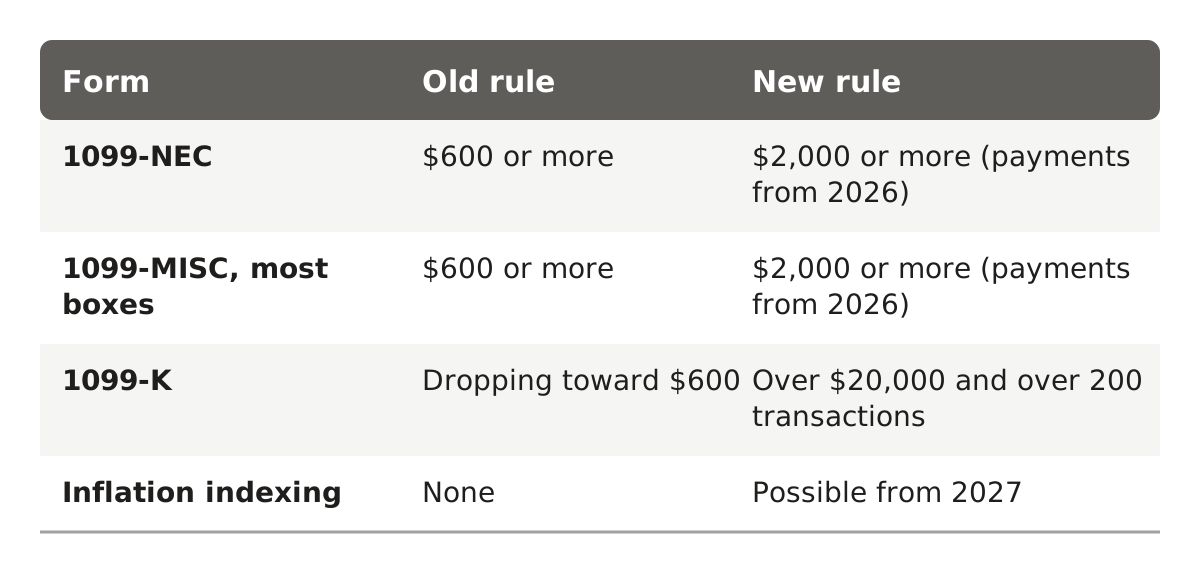
- Form 1099-NEC. For payments made after December 31, 2025, you report nonemployee compensation to a payee once the total for the year reaches $2,000.
- Form 1099-MISC. The same $2,000 threshold applies to boxes such as rents, prizes and awards, other income, and medical and health care payments. Some boxes keep their own figures. Royalties are still reportable at $10, and the box for direct sales of consumer products for resale still uses $5,000.
- Backup withholding. The IRS instructions say the higher minimum also applies when deciding whether you have to backup withhold on these payments, for example when a payee won’t give you a taxpayer identification number.
- Inflation adjustments. The $2,000 figure may be adjusted for inflation starting in calendar year 2027. The IRS says it will publish the adjusted figure in Publication 1099.
- Form 1099-K. Payment platforms and other third party settlement organizations don’t have to file a 1099-K unless a payee’s gross payments exceed $20,000 and the number of transactions exceeds 200. The law reinstated that test retroactively, so the gradual slide toward a $600 threshold that followed the 2021 American Rescue Plan Act is gone.
Who it affects
Nearly every small business that hires outside help will file fewer forms. A design agency that uses a handful of freelancers for small jobs may drop from a dozen 1099s to three or four. Businesses paying rent to individual landlords, law firms paying expert witnesses or court reporters, and startups paying occasional consultants all get the same relief on the payer side.
Freelancers and contractors will get fewer forms in the mail, and online sellers and people using payment apps for side income will see far fewer 1099-Ks. That’s where people get into trouble. The income is still taxable. A missing form changes what the IRS receives from third parties, not what you owe. If you’re self-employed, keep your own records and set money aside as you go; our tax set-aside calculator helps with that, and our guide to freelancer taxes covers the rest.
Key dates
| Date | What happens |
|---|---|
| July 4, 2025 | The One, Big, Beautiful Bill Act is signed into law |
| October 23, 2025 | The IRS publishes FAQs confirming the $20,000 and 200 transaction test for Form 1099-K |
| Payments made in 2025 | Still reported under the old $600 threshold on the forms you file in early 2026 |
| January 1, 2026 | The $2,000 threshold applies to 1099-NEC and most 1099-MISC payments made from this date |
| Early 2027 | Forms 1099-NEC for 2026 payments are due to payees and the IRS by the usual January 31 deadline |
| From 2027 | The $2,000 figure can be adjusted for inflation |
Don’t mix up the years. The forms you file in January 2026 cover 2025 payments, so the $600 rule still applies to them. The first filing season that benefits from the new threshold is early 2027.
What it means in practice
Take Dana, who runs a two-person marketing agency in Columbus, Ohio. In 2026 she pays a copywriter $1,800, a photographer $2,400 and a web developer $9,000, all as independent contractors.
- Under the old rule she’d file three Forms 1099-NEC.
- Under the new rule she files two: one for the photographer and one for the developer. The copywriter falls under $2,000.
- Dana still deducts all $13,200 as a business expense. The filing threshold has nothing to do with whether a cost is deductible.
- The copywriter still reports the $1,800 as income on her own return.
Now suppose Dana hires the copywriter again in December for a $300 job. The total becomes $2,100 and a form is required after all. That’s why I’d tell every client to keep collecting a Form W-9 from each contractor before the first payment, whatever the amount. Chasing a tax ID in late January from someone you paid once in March is a miserable way to spend a week.
For online sellers the difference is bigger. Someone who sold $4,000 of used camera gear through a payment app in 2025 might have expected a 1099-K under the old phased plan. Under the reinstated rules, the platform generally won’t send one unless that seller goes over $20,000 and more than 200 transactions. Any gain on those sales is still reportable, though.
What to do now
- Finish your 2025 forms under the $600 rule. Nothing changes for this filing season.
- Update your accounts payable process so 2026 payments are tracked per payee against the $2,000 figure, not $600.
- Keep getting a W-9 before paying any new contractor. Payees can cross the line late in the year.
- Check the box-specific thresholds in the IRS instructions for anything unusual you pay, such as royalties.
- Check your state’s rules. Some states run their own information-return requirements, and they may not follow the federal change on the same schedule.
- If you’re on the receiving end, keep your own income records. Fewer forms means the IRS will lean more on what you report yourself.
- Review your contractor agreements so they require a W-9 and correct tax details up front, and make sure you’re classifying people correctly as an independent contractor or employee.
Sources
- IRS: Instructions for Forms 1099-MISC and 1099-NEC
- IRS: FAQs on the Form 1099-K threshold under the One, Big, Beautiful Bill
- IRS: Publication 1099, General Instructions for Certain Information Returns
- IRS: About Form 1099-NEC, Nonemployee Compensation
This article is general information, not legal or tax advice. Laws differ between countries and states and change over time, so check the rules that apply to you or speak to a qualified professional.