100% bonus depreciation returns for good: what it means for 2026
The 2025 tax law, the One, Big, Beautiful Bill Act, made three changes that matter to almost any US business that buys equipment or pays for development work. Qualifying property acquired after January 19, 2025 can be written off in full in the year it’s placed in service, and that 100% bonus depreciation no longer has an end date. The Section 179 expensing cap is $2,500,000 for tax years beginning in 2025 and $2,560,000 for 2026. And domestic research and experimental costs can be deducted right away again, for tax years beginning after December 31, 2024. On January 14, 2026 the IRS released Notice 2026-11 with interim guidance on the bonus depreciation rules.
If you spent the last few years spreading laptop and van purchases over depreciation schedules, or capitalizing your developers’ salaries, this is the part of the law that affects your cash flow most.
What changed
Bonus depreciation goes back to 100%, permanently
Under the 2017 rules, bonus depreciation had been stepping down year by year. The new law replaces that phase-down with a permanent 100% first-year deduction for qualified property acquired after January 19, 2025. The acquisition date is what matters, so check when you actually committed to anything bought around mid-January 2025.
There’s a choice for the first year. For the tax year that includes January 20, 2025, you can elect to take 40% instead of 100% on property acquired after January 19 (60% for certain property with longer production periods and certain aircraft). Why would anyone take less? Mostly to avoid creating a loss you can’t use this year, or to keep deductions for years when you expect more income. Notice 2026-11 also covers new categories, such as qualified sound recording productions.
Section 179 limits rise
For tax years beginning in 2025, you can expense up to $2,500,000 of Section 179 property, reduced dollar for dollar once the cost of Section 179 property you place in service goes over $4,000,000. Revenue Procedure 2025-32 sets the 2026 figures at $2,560,000, with the phase-out starting at $4,090,000. The cap on sport utility vehicles for 2026 is $32,000.
US research costs are deductible again
A new section 174A lets you deduct domestic research or experimental expenditures for tax years beginning after December 31, 2024. You can instead choose to capitalize them and amortize over at least 60 months. Foreign research costs still have to be amortized over 15 years.
Small businesses get an extra option. Under Revenue Procedure 2025-28, eligible taxpayers with average annual gross receipts under $31 million can apply the new rule back to tax years beginning after December 31, 2021, which means amending returns for years when those costs had to be capitalized. The window closes on the earlier of July 6, 2026 or the date the statute of limitations runs out for that year.
Who it affects
- Any business buying machinery, vehicles, computers, furniture or other depreciable equipment.
- Software companies, product developers and manufacturers with in-house research staff in the US.
- Small businesses under the $31 million gross receipts line that capitalized research costs in 2022 to 2024 and could now claim refunds.
- Accountants and lawyers advising on the timing of asset purchases and on sales of businesses, where the tax treatment of equipment affects price.
Key dates
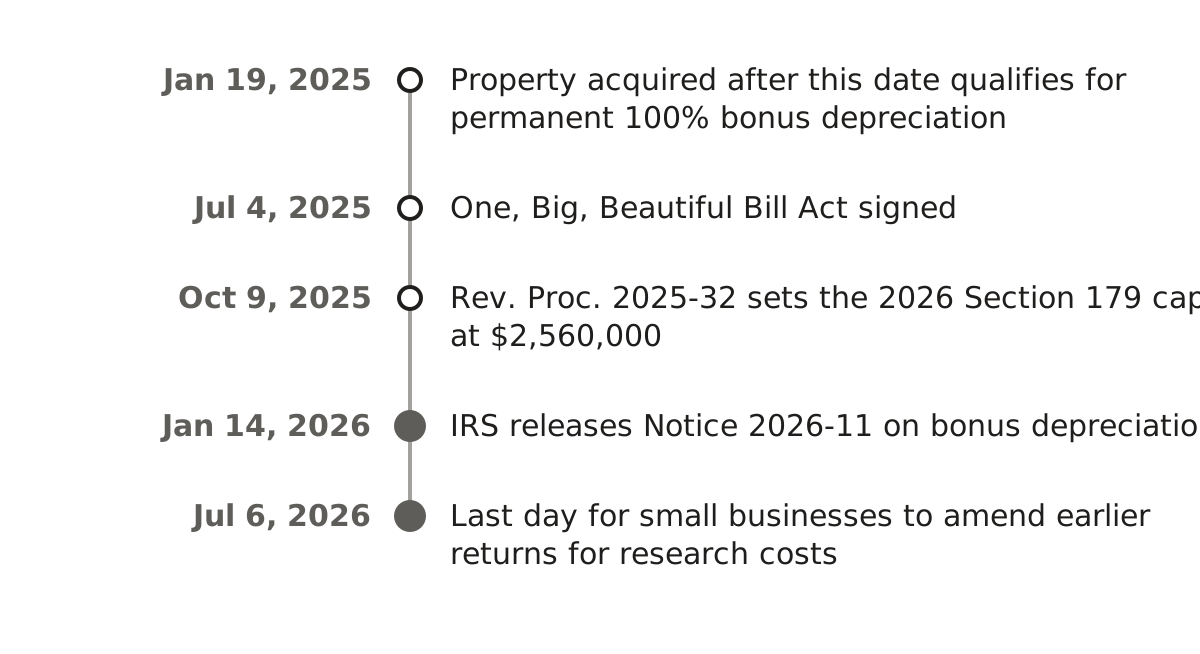
| Date | What it means |
|---|---|
| January 19, 2025 | Property must be acquired after this date for permanent 100% bonus depreciation |
| July 4, 2025 | The law is signed |
| October 9, 2025 | Rev. Proc. 2025-32 sets 2026 Section 179 figures |
| January 14, 2026 | IRS releases Notice 2026-11 on bonus depreciation |
| Tax years beginning in 2026 | Section 179 cap of $2,560,000, phase-out from $4,090,000 |
| July 6, 2026 | Last day (at the latest) for small businesses to amend earlier returns for research costs |
What it means in practice
Lena runs a landscaping company in Tucson that files on a calendar year. In March 2026 she buys $85,000 of mowers, a trailer and tools and puts them to work that month. With 100% bonus depreciation she can deduct the full $85,000 on her 2026 return. If her marginal federal rate is 24%, that’s roughly $20,400 less federal tax for 2026. Under the old phase-down schedule only part of that cost would have qualified for bonus, and the rest would have been spread over several years.
Be clear about what this is. It’s a timing benefit. Lena gets the same total deduction either way; she just gets it now. And if she sells that equipment later, the depreciation she claimed can come back as taxable gain. Buying a truck you don’t need to save tax is still a bad trade.
Second example: a software startup in Austin with $400,000 of US developer salaries in 2025. Under section 174A it can deduct that amount in 2025 instead of amortizing it. If it also capitalized $300,000 of research costs in 2023 and its gross receipts are under the limit, it can look at amending that year by July 6, 2026 to pull the deduction forward.
What to do now
- List every asset bought in 2025 with its acquisition date. Anything acquired on or before January 19, 2025 follows the old rules.
- Decide, with your accountant, whether the 40% election makes sense for your 2025 return.
- Plan 2026 purchases against the $2,560,000 Section 179 cap and the $4,090,000 phase-out.
- If you do research in the US, separate domestic from foreign costs in your books now.
- If you’re a small business that capitalized research costs in 2022 to 2024, get the amended return analysis done well before July 6, 2026.
- Check whether your state follows the federal rules. Some states don’t adopt federal depreciation changes.
- Keep invoices and in-service records. Our invoice generator and guide to deductible business expenses can help you keep the paper trail tidy.
As of January 2026, Notice 2026-11 is interim guidance, so some details may still change.
Sources
- IRS: Guidance on the additional first year depreciation deduction (Notice 2026-11)
- IRS: One, Big, Beautiful Bill provisions
- IRS: Revenue Procedure 2025-32 (2026 inflation adjustments)
- IRS: Revenue Procedure 2025-28 (research and experimental expenditures)
This article is general information, not legal or tax advice. Laws differ between countries and states and change over time, so check the rules that apply to you or speak to a qualified professional.